
We invite you to explore the life of Charles Freer Andrews, a man whose dedication to social justice reshaped the history of two continents. Charles Freer Andrews was one of 14 children, a family background that later influenced his ‘Friend of the Poor’ nickname and commitment to communal living.
Key Takeaways
| Question | Answer |
|---|---|
| Who was C. F. Andrews? | He was an English priest, educator, and social reformer who became a close ally of the Indian independence movement. |
| What does ‘Deenabandhu’ mean? | The title means “Friend of the Poor,” a name given to him by the people of India for his selfless service. |
| How did he help India? | He fought against the indentured labor system and acted as a mediator between Indian leaders and British authorities. |
| Where can I find more on him? | You can read our full Charles Freer Andrews Biography for a deeper look at his life. |
| Who were his closest friends? | He maintained a deep friendship with Mahatma Gandhi and Rabindranath Tagore throughout his life in India. |
Early Life and Education of Charles Freer Andrews
We look back to Newcastle upon Tyne, where Charles was born into a large and devout family in 1871. His father served as a minister in the Catholic Apostolic Church, instilling a sense of deep spiritual purpose in young Charles.
He eventually moved to Birmingham for his schooling before attending Pembroke College, Cambridge. It was during these academic years that he discovered his passion for theology and social concerns.
After his ordination as a priest in the Church of England, he worked in the slums of London and Birmingham. We see these early experiences as the foundation for his lifelong commitment to the marginalized and the oppressed.
The Journey to India: St. Stephen’s College and Delhi
In 1904, Charles Freer Andrews joined the Cambridge Mission to Delhi and began teaching at St. Stephen’s College. We find that this move was the most significant turning point in his entire biography.
He quickly became frustrated with the racial prejudices and the superiority complex displayed by many colonial officials. This disillusionment led him to seek a deeper connection with the Indian people and their rich cultural heritage.
While at the college, he befriended several Indian intellectuals who challenged his Western viewpoints. These interactions encouraged him to support the growing demand for Indian self-rule and educational reform.
Transforming Perspectives: The Influence of the Delhi Renaissance
We recognize that Andrews was deeply influenced by the intellectual atmosphere of early 20th-century Delhi. He played a vital role in documenting the scientific and literary advancements made by Indian scholars during this period.
His involvement in the development of Urdu scientific translations highlighted his respect for local languages. We believe this work helped bridge the gap between Western education and traditional Indian knowledge systems.
As of 2026, scholars continue to study his “Delhi Renaissance” theory to understand the evolution of modern Indian thought. His willingness to learn from his students and colleagues set him apart from typical colonial educators.
Did You Know?
The Indian indentured labor system that Andrews successfully campaigned to abolish involved approximately 3.5 million people transported across British colonies.
Source: The Interfaith Observer
Meeting Gandhi: The Start of a Lifelong Partnership
The year 1914 marked a historic moment when Andrews traveled to South Africa to assist the Indian community there. We see this trip as the beginning of his legendary collaboration with a young lawyer named Mohandas Karamchand Gandhi.
He was immediately impressed by Gandhi’s philosophy of non-violence and his simple way of living. If you are interested in this period, you can read our Mahatma Gandhi Biography for more context on their work together.
Andrews became a trusted advisor and a bridge between Gandhi and the British administration. Their friendship remained a pillar of the independence movement for over two decades until Andrews passed away.
Campaigning Against Indentured Labor
We consider Andrews’ work against the “vile system” of indentured labor to be his greatest humanitarian achievement. He traveled to Fiji, Mauritius, and East Africa to document the horrific conditions faced by Indian workers.
His reports exposed the systematic abuse and moral degradation inherent in the recruitment of laborers for British plantations. He argued that the disparity in recruitment ratios between men and women was a primary cause of social collapse in labor camps.
By 1920, his relentless advocacy led the British government to officially abolish the indentured labor system. This victory solidified his reputation as a global champion for human rights and worker dignity.
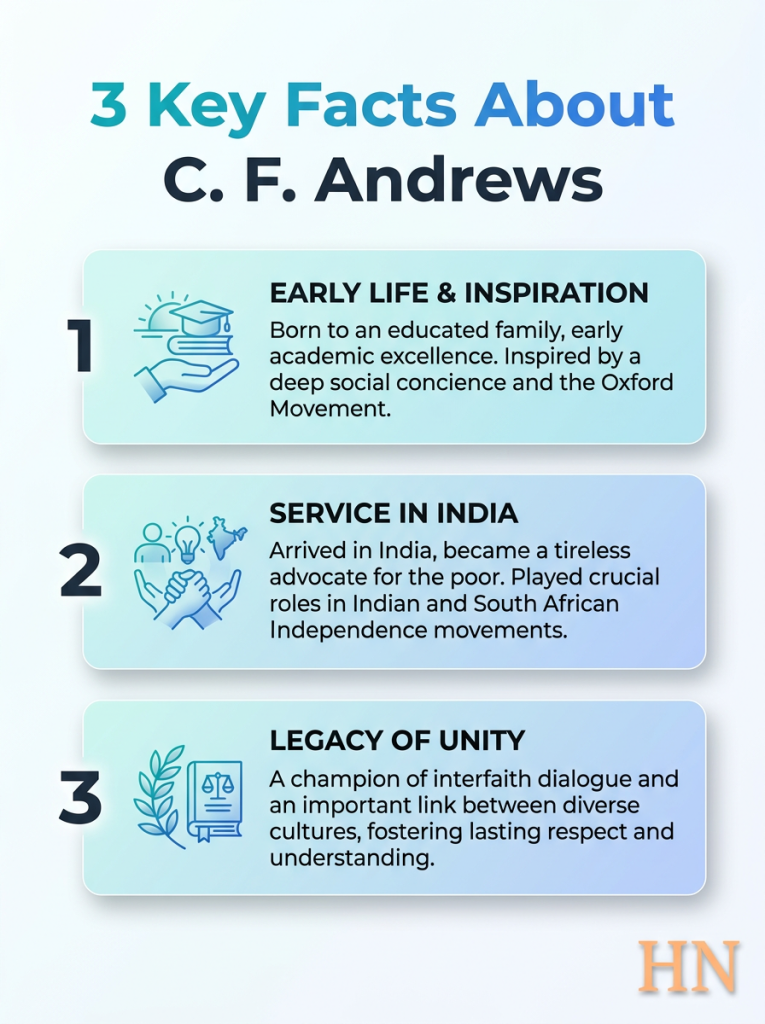
Andrews and the Indian Freedom Struggle
Unlike many of his contemporaries, Andrews openly supported the demand for “Purna Swaraj” or complete independence. We find him working alongside many famous Indian freedom fighters to strategize against colonial rule.
He often acted as a messenger during the Round Table Conferences, ensuring that the Indian perspective was heard in London. His unique position as a British citizen allowed him to influence public opinion in the United Kingdom.
While figures like the Bhagat Singh biography highlight the revolutionary path, Andrews represented the path of moral persuasion and negotiation. He believed that the liberation of India was also a necessary step for the spiritual health of Britain.
Author and Intellectual: The Writings of C. F. Andrews
As of 2026, Andrews is recognized for authoring at least 25 distinct books and reports, providing a window into his complex mind. He was the primary person responsible for introducing Gandhi’s ideas to the Western world through his publications.
His writing style was direct and emotive, focusing on the human cost of political and social policies. We see his works as essential reading for anyone studying the history of the British Empire in India.
His autobiography, “What I Owe to Christ,” remains a classic of spiritual literature, detailing his internal struggles with faith and empire. This book has been translated into numerous languages, demonstrating its enduring global appeal.
Social Reform and Labor Rights
In 1925, Andrews reached a pinnacle of leadership when he served as the President of the All India Trade Union Congress. We view this as proof of his deep involvement in the organized labor movement within India.
He worked tirelessly to improve the safety and pay of railway workers and miners. His approach combined religious ethics with practical socio-economic reforms to help the working class.
He was also a vocal critic of the caste system, working to eliminate the practice of “untouchability” alongside Indian reformers. We believe his legacy in social reform is just as significant as his contributions to the political independence movement.
Did You Know?
Andrews met Mahatma Gandhi on January 1, 1914, in Durban, South Africa, beginning a 26-year friendship that lasted until Andrews’ death in 1940.
Source: Pembroke College, Cambridge
The Legacy of ‘Deenabandhu’ in Modern India
We see the name “Deenabandhu” honored in many educational institutions and hospitals across India today. This title, meaning “Friend of the Poor,” was a genuine reflection of how the common people perceived him.
New research published in February 2026 continues to explore his role in the intellectual life of North India. His biography is often grouped with other modern India biographies as a study in cross-cultural empathy.
He passed away in 1940 in Calcutta, leaving behind a legacy of service that transcends national borders. We remember him not just as a British priest, but as a true son of the Indian soil.
Global Impact: Andrews Beyond the Indian Subcontinent
Andrews’ influence extended far beyond Delhi and Ahmedabad, as he became a voice for the global South. He spent years traveling to Australia and Canada to advocate for the rights of Indian immigrants.
His work highlighted the interconnectedness of racial injustice across the British Empire. We believe his global perspective was ahead of its time, predicting many of the human rights movements of the later 20th century.
He consistently challenged the Church to live up to its ideals of equality and justice in a colonial context. His life serves as a reminder that one individual can indeed change the course of history through compassion and persistence.
Related Historical Figures
To fully understand the era in which Andrews lived, it is helpful to look at his contemporaries and the history they shaped. We recommend exploring these biographies to see the broader tapestry of the time:
- Learn about the Ashfaqulla Khan biography to understand the revolutionary spirit of the youth.
- Read about the life of Chandrashekhar Azad and his commitment to the motherland.
- Explore the Rani Lakshmibai biography for early resistance against the British.
- Check our Ashoka the Great biography for ancient roots of Indian non-violence.
- Study the Guru Gobind Singh biography for a perspective on spiritual leadership.
- Discover the Rajarshi Shahu Maharaj biography for insights into social justice and reform.
- Browse our collection of Indian prince biographies to see the role of royalty in the colonial era.
Conclusion
We conclude that the life of Charles Freer Andrews was a remarkable bridge between the East and the West. His transition from a traditional missionary to the “Deenabandhu” of the Indian poor remains one of the most inspiring stories of the 20th century.
Through his friendship with Gandhi and Tagore, his fight against indentured labor, and his prolific writing, he left an indelible mark on history. As we look back from 2026, his message of universal brotherhood and social justice remains as relevant as ever.
“His love for India was not a matter of words; it was a matter of his life’s blood.” – Mahatma Gandhi on C. F. Andrews
