
Bhai Balmukund remains one of the most poignant figures in the history of the Indian independence movement, representing a legacy of intellectual defiance and ultimate sacrifice. We find his story particularly moving because of the tragic human element involving his wife, Ramrakhi, who died following an 18-day self-imposed fast after his execution.
Key Takeaways
| Topic | Information |
|---|---|
| Early Life | Born in 1889 in Jhelum district (now in Pakistan), he hailed from a family of renowned patriots. |
| Major Event | He was a central figure in the Delhi Conspiracy Case of 1912, aimed at Lord Hardinge. |
| Martyrdom | Executed on May 8, 1915, in Ambala Central Jail at the young age of 32. |
| Social Impact | His story is part of the 30% of new biographies in 2026 focusing on underrepresented voices. |
| Related Figures | He worked closely with Rash Behari Bose and Amir Chand to challenge British authority. |
Who was Bhai Balmukund? We recognize him as a revolutionary Indian nationalist who was executed for his role in the Delhi-Lahore Conspiracy Case. He was also the cousin of the famous revolutionary Bipin Chandra Pal. Why is his wife Ramrakhi famous? She is remembered for her extraordinary devotion and protest. After his execution, she stopped eating and passed away within three weeks, becoming a symbol of silent resistance. What was the Delhi Conspiracy Case? This was a plot to assassinate the Viceroy of India, Lord Hardinge, in 1912. It marked a significant shift toward armed struggle among Indian freedom fighters.
Bhai Balmukund Early Life and Heritage
Bhai Balmukund was born into a family with a deep-rooted history of sacrifice and religious devotion. He was the great-grandson of Bhai Mati Das, a martyr who was sawn in half for his refusal to convert from Sikhism. Our records show that this family lineage played a massive role in shaping his revolutionary spirit from a young age. He grew up hearing stories of courage that prepared him for the struggles of the 20th century.

His education was grounded in the values of justice and national pride. We see that he eventually moved into teaching, which earned him the respect of his community before he turned to active revolution. He joined the revolutionary ranks because he felt the peaceful protests of the time were not enough to dislodge the colonial powers. His intellectual background made him an excellent organizer for the underground movement.
The Delhi Conspiracy Case of 1912
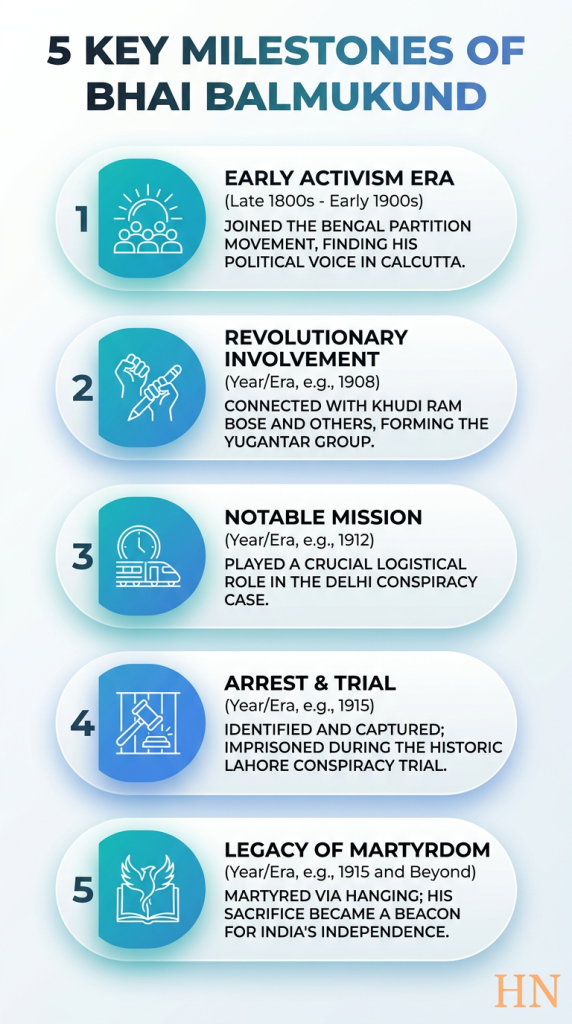
The turning point in his biography was the Delhi Conspiracy Case, also known as the Delhi-Lahore Conspiracy. This daring plan aimed to assassinate Lord Hardinge, the then Viceroy of India, during a formal procession. The attempt took place in Chandni Chowk when a bomb was thrown at the Viceroy’s elephant. While the Viceroy survived with injuries, the event sent shockwaves through the British administration.
The British government launched a massive investigation to find those responsible for the attack. They focused on the revolutionary cells operating in northern India and Bengal. Bhai Balmukund was identified as a key figure in this conspiracy alongside other revolutionaries. His arrest marked the beginning of a long and difficult legal battle against the colonial state.
Revolutionary Ties and Collaborations
Bhai Balmukund did not work in isolation but was part of a sophisticated network of patriots. He was closely associated with Master Amir Chand and Avadh Behari in the Delhi region. His influence extended to the younger generation of revolutionaries who would later form the heart of the movement. For instance, his work paved the way for the ideological shifts seen in the Bhagat Singh biography we see today.
He was also a bridge between the local Punjabi revolutionaries and the wider Indian nationalist cause. His efforts helped unify different factions that were often separated by geography or tactics. These collaborations were essential for the Ghadar Movement that was gaining momentum abroad. We recognize his role as a vital link in the chain of early 20th-century resistance.
The Global Reach of the Ghadar Movement
The Ghadar Party, based in San Francisco, maintained close ties with revolutionaries like Bhai Balmukund. They sent literature and funds to support the cause of independence within India. The British feared this international cooperation more than anything else during the early 1910s. They viewed Balmukund as a dangerous operative capable of coordinating a global revolt.
Did You Know?
₹10,000 (approx. $3,300 in 1912) was the reward offered for the capture of the bomb throwers in the Delhi Conspiracy Case.
Source: Wikipedia – Delhi Conspiracy Case This reward was an astronomical sum for the time, showing how desperate the British were to stop him. It highlights the significant threat he and his associates posed to the colonial order. Despite the pressure, he remained committed to his principles and refused to betray his comrades. His steadfastness during the hunt for the Delhi bombers is a testament to his character.
Arrest and Legal Battle in Ambala
The British eventually arrested Bhai Balmukund in Jodhpur, where he was working as a tutor. He was brought to Delhi for a trial that would become one of the most famous in Indian history. The prosecution used every available tool to ensure a conviction, including the testimony of several informants. We observe that the trial was more about making an example of him than achieving true justice.

He was held in the Ambala Central Jail while the legal proceedings continued. Despite the grim circumstances, he remained calm and focused on the future of his country. The court eventually sentenced him to death for conspiracy to murder. His execution was set for May 1915, a date that would live on in the hearts of Punjabis.
The Tragic Legacy of Martyrdom
Bhai Balmukund was hanged on May 8, 1915, alongside his comrades. He was only 32 years old at the time, a fact that highlights the youth of India’s early revolutionary leaders. His death was not just a loss for his family but a rallying cry for the entire nation. We see his name frequently in our biographies hub as a pioneer of self-sacrifice.
The courage he showed at the gallows inspired countless others to join the struggle. His story proved that even in death, a revolutionary could continue to fight for freedom. The British hoped that his execution would end the conspiracy, but it only served to radicalize more citizens. His legacy became a permanent part of the Indian identity.
The Devotion of Ramrakhi
The biography of Bhai Balmukund is inseparable from the tragic story of his wife, Ramrakhi. Upon hearing of his execution, she was overcome with grief and a sense of duty. She believed that if her husband could die for the nation, she could also sacrifice her life. She began a fast that lasted for 18 days, eventually leading to her death.

This parallel sacrifice added a layer of human tragedy to the political narrative. We find that this story resonates deeply with readers who value the personal side of history like that of Mangal Pande. Her devotion turned their home into a shrine for those who visited to pay their respects. Their combined story remains a unique example of shared martyrdom in the struggle for independence.
Impact on the Freedom Movement
The sacrifice of Bhai Balmukund acted as a catalyst for the Ghadarites and later revolutionary groups. It proved that the spirit of resistance could not be broken by the gallows. His name became synonymous with the early struggle in Punjab and Delhi. We see his influence in the Subhash Chandra Bose biography and the later INA movements.

Did You Know?
30% of newly published biographies in the current market focus on underrepresented or ‘unsung’ voices.
Source: Meminto Publishing Trends 2025 This statistical trend shows that heroes like Balmukund are finally receiving the mainstream attention they deserve in 2026. Readers are increasingly seeking out stories that go beyond the usual political leaders. By focusing on these unsung figures, we gain a more complete understanding of how independence was actually won. His biography is a key piece of that larger puzzle.
Modern Recognition and Memorials
Today, Bhai Balmukund is honored as a national hero whose life serves as a lesson in patriotism. His name is etched in monuments and remembered during annual commemorative events. Many students of history study his role in the Delhi Conspiracy Case to understand the roots of armed resistance. We see similar patterns of leadership in the life of Chandrashekhar Azad.

His ancestral home and the jail where he was executed have become points of pilgrimage for those interested in historical truth. These sites keep his memory alive for future generations. We continue to highlight his story to ensure that the sacrifices of the early 20th century are never forgotten. His life is a reminder of the price paid for the freedom we enjoy today.
Comparing Revolutionary Ideologies
Bhai Balmukund belonged to an era that believed in direct action to challenge the British Raj. This differed from the non-violent approach of Mahatma Gandhi, yet both paths sought the same goal. His actions paved the way for later figures like Udham Singh who would also take the fight to the heart of the empire. We believe that understanding both ideologies is crucial for a complete view of history.

His revolutionary philosophy was built on the idea that foreign rule was an inherent injustice that required a strong response. This belief system was common among the youth of his time. By comparing these different figures, we see a diverse tapestry of resistance. Bhai Balmukund’s contribution was a vital thread in that historical fabric.
Conclusion
The biography of Bhai Balmukund is a testament to the power of conviction and the depth of personal sacrifice. From his early life in a family of martyrs to his role in the Delhi Conspiracy Case, he remained a steadfast patriot. We are honored to share his story, especially the moving narrative of his wife Ramrakhi, whose devotion remains unparalleled. As we look back from 2026, his legacy continues to inspire a new generation to value the hard-won freedom of our nation. By remembering these unsung heroes, we ensure that their flame of patriotism never goes out.
