
The history of India’s independence is filled with legendary figures, yet many remain in the shadows of more prominent names. Did you know that Champakaraman Pillai coined the iconic slogan ‘Jai Hind’ at the age of 13 during a 1907 school inspection in Trivandrum?
This act of rebellion against a British school inspector marked the beginning of a life dedicated to the total liberation of India. In this article, we explore the extraordinary biography of a polymath, strategist, and revolutionary who fought for freedom from the heart of Europe.
Key Takeaways
| Topic | Details and Historical Context |
|---|---|
| Origin of ‘Jai Hind’ | Coined by Pillai in 1907, long before its adoption by the INA. |
| Exile in Europe | Spent decades in Germany and Switzerland organizing revolutionary activities. |
| International Pro-India Committee | Founded this body in Zurich to gain global support for Indian sovereignty. |
| Collaboration with Germany | Worked with German officials during WWI to weaken British imperial hold. |
| Connection to Other Leaders | Influenced many, drawing parallels to the bravery of Chhatrapati Shivaji Maharaj in his defiance. |
Frequently Asked Questions About Champakaraman Pillai
- Who was Champakaraman Pillai? He was an Indian revolutionary born in Travandrum who spent his life in Europe fighting British rule.
- What is his most famous contribution? He is the original creator of the slogan “Jai Hind,” which remains a national greeting today.
- Did he ever return to India? Unfortunately, he passed away in Germany in 1934 and never saw the independent India he envisioned.
- How does his legacy compare to other rulers? Like the strategic minds behind the Maratha Empire, Pillai used international diplomacy and military strategy.
The Early Years in Travandrum and the 1907 Incident
Champakaraman Pillai was born on September 15, 1891, in the princely state of Travandrum, modern-day Kerala. We recognize his early environment as a place of rising national consciousness and intellectual fervor.
His father, Chinnaswami Pillai, worked for the local government, while his mother, Nagammal, instilled strong cultural values in him. Even as a child, he displayed a fiery temperament and a deep-seated resentment toward colonial authority.
The turning point in his young life occurred during a routine inspection at his school by a British official. When the official expected a submissive greeting, the 13-year-old Pillai stood tall and shouted “Jai Hind” for the first time.
This bold gesture was not just a teenage whim but a calculated act of defiance against the British Crown. We see this same spirit of resistance in the history of great warriors like Shivaji Raje who refused to bow to foreign powers.

Facing pressure from the authorities after this incident, Pillai’s family realized he was no longer safe in Travandrum. A fortuitous meeting with a British naturalist named Sir Walter Strickland paved the way for his journey to Europe.
Strickland was impressed by the boy’s intellect and offered to take him to Italy and later to Switzerland. We believe this migration was the catalyst that transformed a local rebel into an international revolutionary diplomat.
European Exile and the International Pro-India Movement
Arriving in Europe, Pillai quickly adapted to the intellectual landscape of Switzerland and Germany. He pursued higher education in engineering and political science, mastering the tools he would later use against the British.
While studying, he never lost sight of his primary goal, which was the total independence of his motherland. He began networking with other Indian expatriates and European sympathizers who shared his anti-imperialist views.
In 1914, he established the International Pro-India Committee in Zurich, serving as its president. This organization aimed to provide a platform for Indian voices on the global stage, free from British censorship.
We can compare this diplomatic maneuvering to the complex alliances formed during the reign of Rani Tarabai during the Maratha-Mughal wars. Both leaders understood that survival required more than just physical force; it required strategic international partnerships.

The committee published journals and pamphlets that exposed the economic exploitation of India by the British Raj. These publications reached intellectual circles across Europe, slowly turning public opinion against the British Empire.
Pillai believed that if the world understood the true nature of colonial rule, the British would lose their moral standing. His efforts in Zurich laid the groundwork for the more aggressive revolutionary movements that emerged during World War I.
The Berlin Committee and Global Revolutionary Networks
As World War I loomed, Pillai moved to Berlin, recognizing that Germany was the natural rival of Great Britain. He joined forces with the Berlin Committee, also known as the Indian Independence Committee.
This group consisted of some of the most brilliant Indian minds in exile, including Virendranath Chattopadhyaya and Lala Hardayal. We see this period as a high point of Indian revolutionary activity on foreign soil.
The committee worked closely with the German Foreign Office to plan an armed insurrection within India. They hoped to ship arms and ammunition to Indian revolutionaries through secret maritime routes.
Pillai’s role was crucial as he acted as a bridge between the Indian activists and the German military staff. He was not just a philosopher but a man of action who understood the logistics of warfare.

During this time, he also engaged in psychological warfare, broadcasting anti-British propaganda to Indian soldiers serving in the British Army. He urged them to turn their guns against their oppressors rather than fighting for a king who enslaved their families.
His work was reminiscent of the wide-reaching influence of the Pushyamitra Shunga dynasty, which sought to restore traditional sovereignty. Pillai envisioned a modernized India that retained its ancient pride while adopting global technological advances.
The Strategic Visionary: Collaboration with German Intelligence
Working within the heart of the German Empire allowed Pillai access to high-level intelligence and military strategy. We recognize that his collaboration was born of necessity rather than a preference for German ideology.
He famously accompanied the German cruiser SMS Emden on its mission in the Indian Ocean. This vessel struck fear into the British Navy and even bombarded British installations in Madras (now Chennai).
Pillai’s presence on the ship was symbolic; it was the first time an Indian revolutionary had participated in a naval attack against the British. He hoped this would inspire a general uprising among the Indian population along the coast.
Though the Emden was eventually sunk, the psychological impact on the British was immense. They realized that Indian revolutionaries were now capable of coordinating with world powers to strike at the heart of the empire.
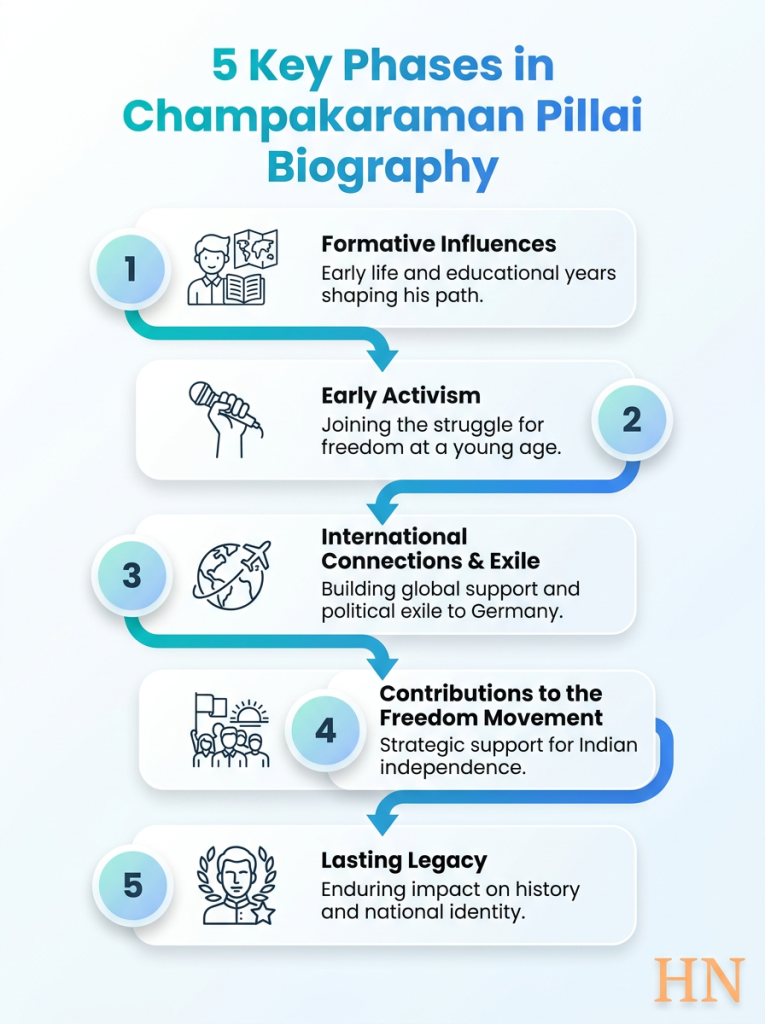
Pillai continued to advise the German government on Indian affairs throughout the remainder of the war. He was instrumental in drafting plans for an Indian provisional government to be established in Kabul.
This vision of a sovereign government-in-exile was a precursor to the later efforts of the Indian National Army. We believe his strategic foresight was decades ahead of its time, providing a template for future freedom fighters.
Intellectual Giant: Mastering 12 Languages
One of the most remarkable aspects of Champakaraman Pillai was his immense intellectual capacity. He was a true polymath who understood that language was a powerful weapon in the struggle for liberation.
Over the course of his life in Europe, he attained mastery over 12 different languages. This linguistic prowess allowed him to communicate directly with leaders from Germany, Italy, France, and various Middle Eastern nations.
He could write scholarly articles in German, deliver fiery speeches in English, and coordinate with fellow revolutionaries in his native Tamil or Malayalam. We see this as a key factor in his ability to build a truly global network.
His ability to navigate different cultures and tongues earned him the respect of the European elite. He was often seen in the company of philosophers, scientists, and high-ranking diplomats in Berlin and Zurich.
Did You Know?
Champakaraman Pillai was a polymath who attained mastery over 12 different languages, allowing him to establish anti-British revolutionary networks across Switzerland, Germany, and the Middle East.
Source: YouTube – All India Radio
This linguistic skill also made him a dangerous adversary for the British Secret Service. They found it difficult to track his correspondence, as he frequently switched between languages and codes to maintain secrecy.
His academic background also allowed him to work as an expert in technical fields, which provided him with a legitimate income. We admire how he balanced his professional life with his relentless pursuit of national freedom.
The Vienna Connection: Meeting Subhas Chandra Bose
The year 1919 was a significant one for the Indian freedom movement, both at home and abroad. It was during this year in Vienna that Champakaraman Pillai met with a young and ambitious Subhas Chandra Bose.
This meeting is often cited by historians as a critical juncture in the development of the Indian National Army (INA) concept. Pillai shared his experiences of working with the German military and his belief in an armed struggle from outside India.
Bose was deeply impressed by Pillai’s vision and his established networks in Central Europe. They discussed the possibility of raising an Indian army from prisoners of war and expatriates to march toward Delhi.
We can see the influence of Pillai’s ideas in Bose’s later actions during World War II. The slogan ‘Jai Hind’, which Pillai had carried with him since childhood, was eventually adopted by Bose for the INA.
“Pillai’s meeting with Bose in 1919 proved he was a visionary strategist for the INA over two decades before its peak fame.”
This collaboration between two giants of the freedom struggle bridged two different generations of revolutionaries. While Pillai provided the foundation and the international blueprint, Bose later provided the mass mobilization and leadership.
Their shared conviction that “England’s difficulty is India’s opportunity” remained a guiding principle for the remainder of their lives. We recognize this synergy as a vital part of the global effort to dismantle the British Empire.
Political Ideology and the Concept of Independent India
Pillai’s political ideology was not limited to just removing the British; he had a clear vision for the future of the country. He believed in a strong, unified India that could stand as an equal among the nations of the world.
He was a proponent of industrialization and scientific education, believing these were necessary for true sovereignty. We find his writings from the 1920s filled with detailed plans for India’s economic and social reconstruction.
Despite his collaboration with Germany, he remained a staunch Indian nationalist first and foremost. He never allowed foreign interests to dictate the goals of the International Pro-India Committee.
His concept of “Jai Hind” was more than just a greeting; it was a philosophy of national victory and self-respect. It encapsulated the desire of a people to reclaim their identity after centuries of colonial rule.
We often compare his role to the ideological mothers of empires, such as Jijabai, who shaped the values of future leaders. Pillai sought to mother the modern Indian state through his intellectual and revolutionary contributions.
He envisioned a republic where every citizen, regardless of caste or creed, would work toward the common goal of national progress. This inclusive vision was revolutionary in an era often defined by sectarian and regional divisions.
Personal Life, Marriage, and Final Years in Berlin
Behind the revolutionary facade, Pillai lived a life of great personal sacrifice and emotional depth. In 1931, he married Lakshmi Bai, a woman of Indian descent who shared his passion for the cause.
Their marriage was a partnership of ideals, as Lakshmi Bai supported his work despite the constant surveillance and financial hardships they faced. We know that the life of an exile is often lonely and fraught with danger.
As the political climate in Germany changed with the rise of the Nazi party, Pillai found himself in a difficult position. While he had worked with German officials for years, he did not subscribe to the racial theories of the new regime.
His health began to decline in the early 1930s, exacerbated by the stress of his work and the realization that the British were still firmly in power. He suffered from various ailments, including suspected poisoning by Nazi sympathizers who viewed his independence unfavorably.
In May 1934, Champakaraman Pillai passed away in Berlin at the relatively young age of 42. His final wish was for his ashes to be returned to his beloved motherland once it was free.
We reflect on his death as a tragic loss for the movement, occurring just as global tensions were once again reaching a boiling point. He died as he had lived—a patriot in a foreign land, dreaming of a free India.
The Legacy of Jai Hind in Modern India (2026)
As we look back from the year 2026, the legacy of Champakaraman Pillai is more visible than ever. The slogan “Jai Hind” has transcended its revolutionary roots to become the official greeting of the Indian state and its armed forces.
It is used by millions every day, from the highest levels of government to school assemblies in small villages. We see this as a testament to the power of a single idea born in the mind of a 13-year-old boy in 1891.
In recent years, there has been a significant push to document and honor the lives of “unsung heroes” like Pillai. Digital archives and national projects have brought his story to a new generation of students and history enthusiasts.
Did You Know?
Pillai met Subhas Chandra Bose in Vienna in 1919 to strategize the Indian National Army (INA) concept, proving his visionary status over two decades before the INA’s peak.
Source: International Journal of Humanities
The sentiment toward the “Jai Hind” slogan remains overwhelmingly positive in 2026, serving as a unifying force across the diverse landscape of India. It represents a shared history of struggle and a collective hope for the future.
We acknowledge that without the tireless diplomatic efforts of individuals like Pillai, the international pressure on Britain would have been significantly less. His life reminds us that the fight for freedom was fought on many fronts, including the intellectual and diplomatic theaters of Europe.
Recognition and Modern Commemorations
For many years, Pillai’s contributions were overshadowed by the more mainstream leaders of the independence movement. However, the 21st century has seen a revival of interest in his biography and his specific role in the revolution.
Statues and memorials have been erected in his honor, most notably in Chennai and his birthplace, Kanyakumari. We believe these physical tributes are necessary to ground his legend in the actual soil of the land he fought for.
His ashes were finally brought back to India in 1966, fulfilling his dying wish, and were ceremoniously immersed in the waters of Kanyakumari. This event marked the symbolic homecoming of a hero who had spent his entire adult life in exile.
The Indian government has also issued commemorative stamps and coins featuring his likeness to ensure his face is as recognizable as his slogan. We see this as a long-overdue recognition of a man who gave everything for the nation.
Educational curricula in 2026 now include detailed chapters on the “Global Indian Revolutionaries,” placing Pillai alongside other greats. This shift ensures that his name is no longer a footnote but a central part of the national narrative.
His story serves as an inspiration for many young Indians today who seek to contribute to their country while living abroad. Pillai proved that one’s patriotism is not defined by where they reside, but by where their heart and efforts are directed.
Conclusion
The biography of Champakaraman Pillai is a stirring account of brilliance, bravery, and unyielding patriotism. From the classrooms of Travandrum to the high offices of Berlin, he remained a steadfast soldier of the Indian cause.
His creation of the slogan “Jai Hind” provided a voice for a nation that was struggling to find its own. We honor his memory by remembering the depth of his sacrifice and the clarity of his vision for a modern, independent India.
As we move further into 2026, let us carry the spirit of Pillai with us in our own endeavors. His life teaches us that through intellect, strategy, and courage, even the smallest voice can echo through the centuries and change the course of history.
