
We invite you to explore the courageous life of Damodar Hari Chapekar, the man who ignited the flame of armed revolution against British colonial rule in late 19th-century India. Nearly 50% of Pune’s population fled the city during the devastating 1897 plague that prompted Chapekar’s decisive actions against the oppressive measures of the British administration.
Key Takeaways
| Key Information | Details |
|---|---|
| Full Name | Damodar Hari Chapekar |
| Known For | Assassination of W. C. Rand in 1897 |
| Influenced By | Bal Gangadhar Tilak |
| Birth Place | Chinchwad, Pune, Maharashtra |
| Martyrdom Date | April 18, 1898 |
Common Questions About Damodar Hari Chapekar:
- Why did Damodar Chapekar kill W.C. Rand? He sought to avenge the atrocities committed by the British during the 1897 Pune plague.
- Who were the Chapekar brothers? They were Damodar, Balkrishna, and Vasudeo, all of whom were executed for their revolutionary activities.
- What was the Chapekar Club? It was an organization focused on physical training and nationalist education among young Indians.
- How did Chapekar influence the freedom struggle? His actions paved the way for later revolutionaries like Bhagat Singh.
Early Life and Cultural Background in Chinchwad
Damodar Hari Chapekar was born on June 24, 1870, into a Konkanastha Brahmin family in Chinchwad, near Pune. His family had a rich tradition of Kirtan, which involved religious storytelling through music and poetry.
We recognize that his upbringing in a deeply cultural and spiritual environment shaped his strong moral compass and patriotic fervor. Along with his brothers Balkrishna and Vasudeo, he received a traditional education that emphasized Indian values over Western ideals.
His father, Hari Vinayak Chapekar, was a well-known Kirtankar who instilled a sense of pride in Indian heritage. This foundation served as the bedrock for his future revolutionary path against foreign domination.
The Influence of Lokmanya Tilak and the Chapekar Club
In the late 19th century, Pune was the center of nationalist thought, largely led by Bal Gangadhar Tilak. Damodar Chapekar was deeply influenced by Tilak’s calls for “Swaraj” or self-rule.
We find that the brothers frequently attended Tilak’s lectures and read his newspaper, Kesari, which criticized the British government. This intellectual awakening moved them from passive observers to active participants in the struggle.
Damodar founded an organization dedicated to the physical and mental training of youth. This group, often called the Chapekar Club, focused on traditional exercises, wrestling, and the study of Hindu scriptures to build a disciplined revolutionary force.

The 1897 Pune Plague and British Tyranny
The year 1897 brought a catastrophic bubonic plague to Pune, leading the British to appoint W. C. Rand as the Plague Commissioner. Rand’s administration used brutal methods to “control” the disease, including forced entry into homes and the destruction of property.
We note that British soldiers often insulted residents and violated the sanctity of domestic spaces under the guise of health inspections. These actions caused widespread resentment and a sense of deep humiliation among the local population.
Damodar Chapekar and his brothers witnessed these atrocities firsthand and decided that a symbolic act of retaliation was necessary. They viewed the British response not as medical aid but as a deliberate attempt to break the spirit of the Indian people.
The Assassination of Commissioner W. C. Rand
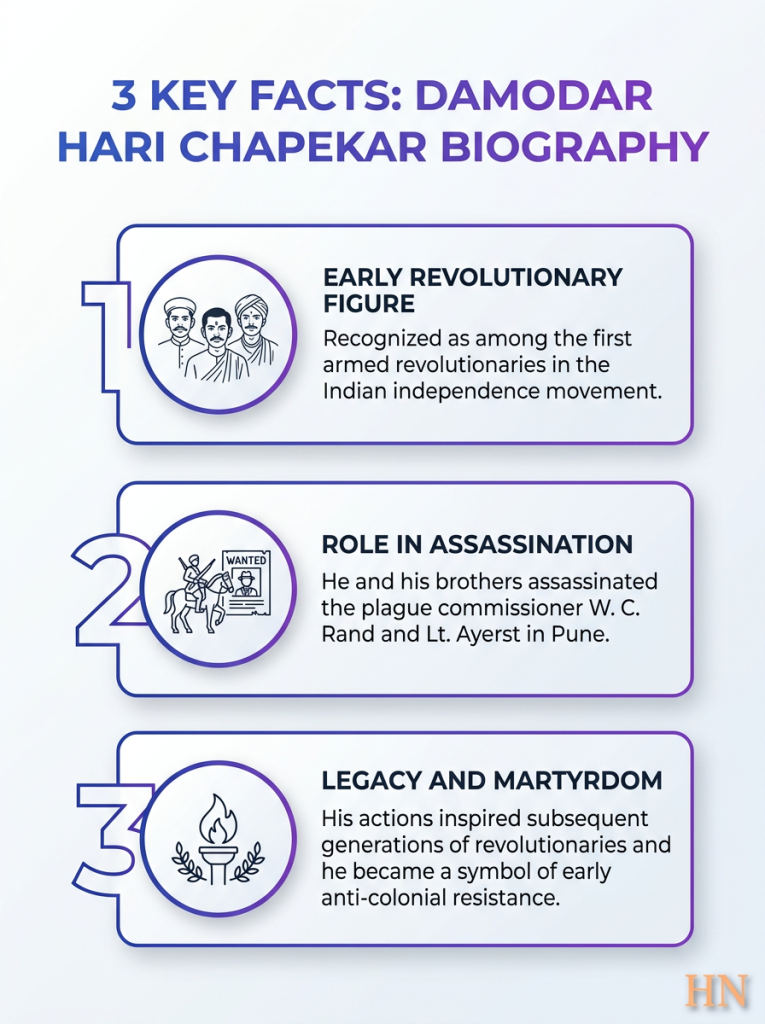
On the night of June 22, 1897, during the celebrations for Queen Victoria’s Diamond Jubilee, the Chapekar brothers executed their plan. They waited at Ganeshkhind Road as Rand’s carriage approached from the Government House.
Damodar climbed onto the back of the carriage and shot W. C. Rand at point-blank range, while his brother Balkrishna shot Lieutenant Ayerst, who was in another carriage. Both British officers later died from their wounds.
We consider this event the first significant political assassination by Indian revolutionaries in the modern era. It sent shockwaves through the British administration and signaled a new, militant phase of the freedom struggle.
Arrest, Trial, and the Chapekar Brothers’ Sacrifice
Following the assassination, the British government launched a massive manhunt and offered a reward of ₹20,000 for information. The Dravid brothers, who were associated with the Chapekar Club, eventually betrayed Damodar and his siblings.
Damodar was arrested in Mumbai and faced trial in Pune, where he famously confessed to the act without any remorse. He stated that his motivation was to protect the honor of his motherland and his religion.
We honor his bravery as he walked to the gallows on April 18, 1898, clutching a copy of the Bhagavad Gita. His brothers, Balkrishna and Vasudeo, along with their associate Mahadev Ranade, were also executed in the following months.

Impact on Future Revolutionary Movements
The martyrdom of the Chapekar brothers became a source of immense inspiration for subsequent generations of Indian revolutionaries. Figures like Vinayak Damodar Savarkar were deeply moved by their sacrifice.
We observe that the Chapekar brothers’ actions proved that the British were not invincible and that direct action was a viable path to independence. This radical shift in strategy eventually led to the rise of groups like the Hindustan Socialist Republican Association.
Their story bridged the gap between the traditional resistance of 1857 and the modern revolutionary movements of the early 20th century. By 2026, their biography remains a cornerstone of patriotic education across India.
Did You Know?
The new Krantiveer Chapekar Memorial in Pune was developed with a budget of ₹50 crore.
Source: Times Now / Hindustan Times
Chapekar Wada and Modern Memorials in Pune
The ancestral home of the brothers, known as Chapekar Wada, has been preserved as a historical landmark in Chinchwad. We encourage students and history enthusiasts to visit this site to understand the environment that produced such bold leaders.
In recent years, the government has invested heavily in expanding these memorials to include interactive exhibits and research centers. These efforts ensure that the legacy of the Chapekars is not lost to time but continues to inform national identity.
The site now hosts annual commemorations on the brothers’ death anniversaries, drawing thousands of visitors from across the country. We see these memorials as vital living classrooms for understanding the costs of freedom.
Cultural Representations: From Books to Screen
The dramatic story of Damodar Hari Chapekar has been captured in various forms of media over the decades. Literature like “Musings from the Gallows” offers a poignant look at his final thoughts and philosophical convictions.
We are currently seeing a resurgence of interest in their lives through modern television series and digital content. These productions highlight the personal struggles and intense loyalty that defined the brothers’ lives.
Such cultural portrayals help humanize the revolutionaries, moving them from static names in a textbook to relatable figures of immense courage. They serve as a bridge connecting the struggles of the past with the digital-first audience of 2026.
Did You Know?
83% of Indian Gen Z identifies as digital creators who prioritize regional stories like the Chapekar brothers’ biography.
Source: Times of India 2025
Lessons from Chapekar’s Resistance and Philosophy
While the methods of the Chapekar brothers were controversial to some during their time, their unwavering commitment to justice is undeniable. We can learn much from their discipline and their willingness to sacrifice everything for a greater cause.
Their philosophy was rooted in the idea that one must stand up against systemic cruelty, even at the cost of one’s own life. This ethos influenced later movements that balanced revolutionary zeal with organized political strategy.
In 2026, we look back at their lives not just as a history of violence, but as a history of an awakening. They taught India that the status quo of foreign rule was not an permanent state but a condition that could be challenged.
Visiting the Chapekar Memorial in 2026
If you are planning a visit to the Chapekar Memorial this year, you will find a state-of-the-art facility that honors the family’s legacy. The museum now uses AI-guided tours to narrate the specific events of June 1897.
We recommend starting your tour at the original Wada to feel the historical atmosphere before moving to the modern museum wing. The facility is open daily and provides educational resources in multiple regional languages.
This pilgrimage to Pune is essential for anyone wanting to connect with the roots of the Indian revolutionary movement. It remains one of the most significant sites for understanding the transition from the Maratha era to the freedom struggle.
Conclusion
Damodar Hari Chapekar’s life was a testament to the power of conviction and the pursuit of national dignity. We have explored his journey from a cultural upbringing in Chinchwad to his pivotal role in the Rand assassination and his eventual martyrdom.
His legacy continues to inspire millions in 2026, serving as a reminder that the path to freedom was paved by the immense sacrifices of young heroes. By remembering his story, we honor the resilient spirit of India that refused to stay silent under oppression.
