
Did you know that in 1925, Vitthalbhai Patel won the first-ever contested election for the Speaker of the Central Legislative Assembly by a narrow margin of 58 votes to 56, defeating the government’s nominee? This historic victory established a precedent for Indian self-governance that we continue to study and respect in 2026.
Key Takeaways
| Topic | Key Information |
|---|---|
| First Indian Speaker | Vitthalbhai Patel was the first Indian to be elected as the President (Speaker) of the Central Legislative Assembly in 1925. |
| Who was his famous brother? | He was the elder brother of Sardar Vallabhbhai Patel, the Iron Man of India. |
| What was his political party? | He was a co-founder and leading figure of the Swaraj Party alongside Motilal Nehru. |
| Historical Context | His work is often compared to other great Indian freedom fighters who used legislative means for independence. |
| Legacy of Biographies | Researchers today access his life story through various biographies to understand early Indian parliamentary systems. |
| Spiritual Influences | Like many leaders of his era, his values were often rooted in the teachings of figures like Sant Tukaram Maharaj. |
Early Life and Background of Vitthalbhai Patel
Vitthalbhai Jhaverbhai Patel was born on September 27, 1873, in the village of Karamsad, located in the modern state of Gujarat. We recognize him as a pivotal figure who bridged the gap between traditional rural values and modern legislative politics.
He was the third of five sons born to Jhaverbhai Patel and Ladbai, a family that valued hard work and resilience above all else. His upbringing in a landlord family provided him with a unique perspective on the land issues that would later define his political career.
The Patel family was known for its disciplined lifestyle and commitment to the community. These early years in Karamsad shaped his understanding of the grassroots challenges facing India under British rule.

The Rapid Academic Success and London Law Career
Vitthalbhai demonstrated exceptional intellectual capabilities from a very young age, often outshining his peers in academic pursuits. He completed his matriculation and immediately set his sights on the legal profession, which was a gateway to political influence.
His determination led him to London, where he joined the Middle Temple to study law. We find it remarkable that he completed a standard 36-month law course in just 30 months, finishing at the very top of his class.
Upon returning to India, he established a successful legal practice in Godhra and later in Bombay. His reputation as a sharp and fearless lawyer grew rapidly, making him a formidable opponent in the courtroom.
Comparing the Patel Brothers: Vitthalbhai and Sardar Vallabhbhai
The relationship between Vitthalbhai and his younger brother, Sardar Vallabhbhai Patel, was one of mutual respect and shared goals for the nation. While Vallabhbhai became the master organizer, Vitthalbhai was the master of legislative procedure.
There is a famous story that Vitthalbhai used the money and passport intended for Vallabhbhai to go to London first. Vallabhbhai willingly sacrificed his own plans to support his elder brother’s ambitions, showcasing the deep bond they shared.
Despite their occasional political differences, they remained a powerful duo in the Indian National Congress. We believe their combined efforts provided both the grassroots strength and the legislative finesse needed to challenge British authority.
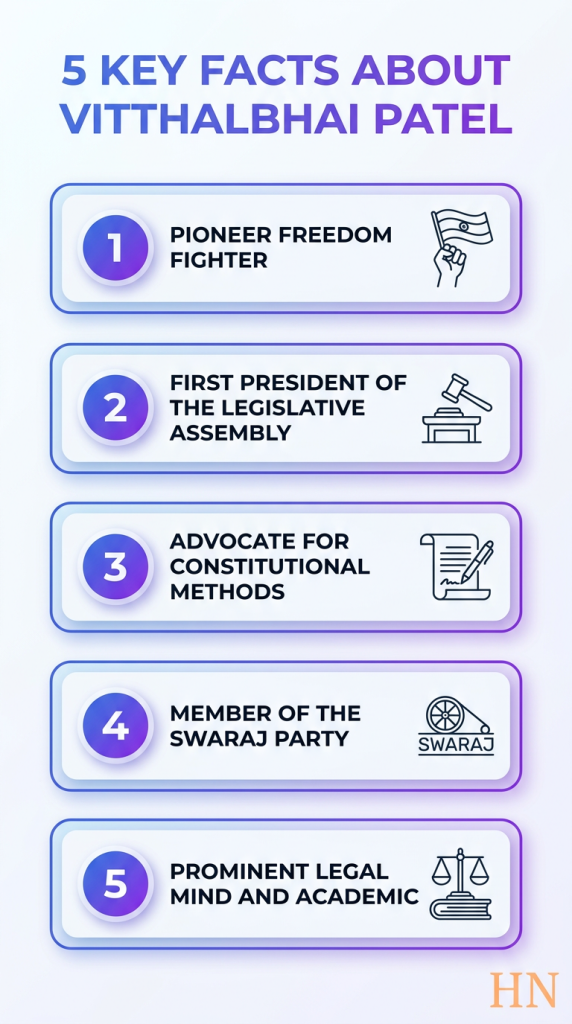
Legislative Prowess and the Central Legislative Assembly
In 1923, Vitthalbhai was elected to the Central Legislative Assembly, where he quickly became known as an expert in constitutional law. He used his deep knowledge to frustrate the British administration at every possible turn.
He believed that the legislative councils should be used as a platform to expose the flaws of colonial rule. This strategy of “obstruction from within” was a hallmark of his political career during the 1920s.
His colleagues often noted his extreme diligence and attention to detail. We can still see the impact of his rigorous questioning of British officials in historical records from that era.
Did You Know?
As a member of the Imperial Legislative Council in 1920, Patel was noted for his extreme diligence, posing 62 questions in just one session to challenge British administration.
Source: Next IAS 2025

A Landmark Speakership: 1925 to 1930
When Vitthalbhai Patel was elected as the President of the Assembly in 1925, he insisted on wearing a Gandhi cap. This was a bold statement of national identity that challenged the formal dress codes of the British-led assembly.
As Speaker, he fought hard to establish the independence of the legislative secretariat. He believed that the legislature must be entirely separate from the executive branch to function truly for the people.
His tenure saw several historic rulings that limited the power of the Viceroy and protected the rights of elected members. We view these years as the foundation of modern parliamentary autonomy in India.

Political Alliances with Motilal Nehru and the Swaraj Party
Vitthalbhai was a key architect of the Swaraj Party, which advocated for entering the legislative councils to wreck the system from within. This stance put him in direct opposition to the “no-changers” within the Congress who favored boycotts.
Working alongside Motilal Nehru, he successfully proved that the legislative arena was a critical front in the fight for independence. Their partnership transformed the way Indian leaders engaged with colonial institutions.
The Swarajists brought a new level of professionalism and strategy to the Indian political landscape. We see their influence in the way modern political parties organize and conduct themselves in 2026.

Defiance of the British Administration and Resignation
In 1930, following the launch of the Salt Satyagraha by Mahatma Gandhi, Vitthalbhai resigned his post as Speaker in protest. He felt that continuing in office was no longer compatible with the escalating struggle for Purna Swaraj.
His resignation was a massive blow to the prestige of the Central Legislative Assembly. It sent a clear message that even the most high-ranking Indian officials were ready to sacrifice their positions for freedom.
Following his resignation, he was arrested and imprisoned multiple times for his participation in the Civil Disobedience Movement. We recognize this period as the peak of his personal sacrifice for the national cause.

Health Struggles and the Final Exile in Europe
Years of political struggle and imprisonment took a heavy toll on Vitthalbhai’s health. In 1932, he traveled to Europe for medical treatment, where he continued his political activism from abroad.
During his time in Europe, he became a vocal critic of the British Empire on the international stage. He worked to build support for India’s independence in countries like Austria and Germany.
He frequently met with international leaders and intellectuals to explain the Indian perspective on self-rule. We appreciate how he used his time in exile to globalize the Indian independence movement.
Did You Know?
Upon his death in 1933, Patel’s funeral procession in Bombay drew a crowd of over 3 lakh (300,000) people, demonstrating his immense popularity despite his frequent disagreements with mainstream leadership.
Source: Wikipedia 2026

The Controversial Will and Friendship with Subhas Chandra Bose
While in Europe, Vitthalbhai developed a close friendship with the young Subhas Chandra Bose. The two leaders shared a common vision for a more militant and internationally focused independence struggle.
In a surprising move, Vitthalbhai willed three-quarters of his estate to Bose to be used for India’s cause abroad. This decision later caused a significant legal and personal rift between Bose and Sardar Vallabhbhai Patel.
The “Patel Will” remains one of the most debated documents in modern Indian history. We study this event to understand the complex internal dynamics and differing visions among India’s founding fathers.
Honoring Vitthalbhai Patel’s Legacy in 2026
Today, Vitthalbhai Patel’s contributions are remembered through various monuments and educational institutions across India. His commitment to parliamentary excellence is particularly honored during the annual Speakers’ Conferences.
We find that his life story offers invaluable lessons in political courage and constitutional integrity. As we navigate the political landscape of 2026, his belief in the power of the legislature remains more relevant than ever.
From the halls of the Delhi Assembly to the quiet village of Karamsad, his name continues to inspire those who believe in justice and self-governance. We strive to keep his memory alive by sharing the remarkable details of his biography with new generations.

Conclusion
The biography of Vitthalbhai Patel is a testament to the power of the law and the legislature in the hands of a determined patriot. We see him not just as a politician, but as a pioneer who defined what it means to be an Indian parliamentary leader.
His legacy is a blend of sharp legal intellect, unyielding national pride, and a fearless willingness to challenge authority. As we reflect on his life in 2026, we are reminded that true independence is built on a foundation of robust institutions and individual courage.
