
Introduction
Before name of India, it was called with name “Bharat”. Some people also referred the Indian Subcontinent with name “Hindustan”, because of combined region of modern India, Pakistan, and Bangladesh. Do you know who at first united this entire region of India?
If you guessed Samrat Chandragupta Maurya, then you are absolutely right. He was the valiant emperor who dedicated his life to keeping this vast land free from foreign invasions, laying the foundation for one of the largest and most powerful empires in ancient India.
Chandragupta’s journey to power is woven with many assumptions due to scarce historical records, yet what we do know is profoundly influenced by the guidance of his brilliant mentor, Acharya Chanakya. A master of economics and polity, Chanakya believed that India needed a strong, unified kingdom to withstand foreign invasions.
He already guessed the upcoming danger from forces like Alexander’s army. Under Chanakya’s mentorship, Chandragupta dared to dethrone the greedy and selfish King Dhanananda of Magadha, taking control of the throne and expanding his dominion.

Despite limited evidence about Chandragupta’s entire life, his achievements speak volumes. He solidified a central authority where none had existed before, forging a robust military, defense, and administrative system that shaped the course of Indian history.
By extending Magadha’s borders to the west and north, he successfully proposed the idea of a united India—transforming it into the formidable Mauryan Empire. Chandragupta remains a testament to courage, determination, and the power of a visionary mind guided by a learned mentor.
Childhood Story and Early Life
There were not sufficient pieces of evidence about his early life. Though, I am describing his origin on basis of some records.

- According to Greek and Latin records, he referred to and mentioned as Sandrokottos or Androcottus.
- According to the Buddhist record, he was Kshatriya and also some Jain records says, he was the son of a village chief. That village was famous for peacock rearing. Buddhist literature tells that Chandragupta was from the same Sakyas clan as Gautam Buddha belongs to.
- Some Hindu literature, like Puranas which was composed after 600 years after the period of Chandragupta, says Chandragupta was from a Shudra peacock rearing family.
- According to Indian Historians, he was orphaned in his childhood and raised by another family.
- Do you know where Maurya came from? Mora, which means peacock in the Pali language. If you don’t know, the Pali language was used in Buddhist literature.
- There was a design of a peacock in the Great Stupa of Sanchi.
In all the above records and pieces of evidence, one thing is common, that is a peacock. So, one thing is clear that there was some relationship between Peacock and the life of Chandragupta. Later, that peacock became a royal symbol of the Maurya dynasty.
The Guru of the Chandragupta Maurya: Acharya Chanakya
- Vishnugupta Chanakya, who was traditionally known as Kautilya.
- Chanakya was the author of the famous book Artha Shastra. It is a 4on economics.
- Artha Shastra is considered ideal for the modern economy. Today’s economy was also somewhat based on his book, Artha Shastra.
- You may already read Chanakya Niti. The book contains thoughts on life of Acharya Chanakya written based on his analysis while interacting with society and Politics. We know the story of Chanakya in that why he took the pledge to end the Nanda Empire and completed his dream of intact India.
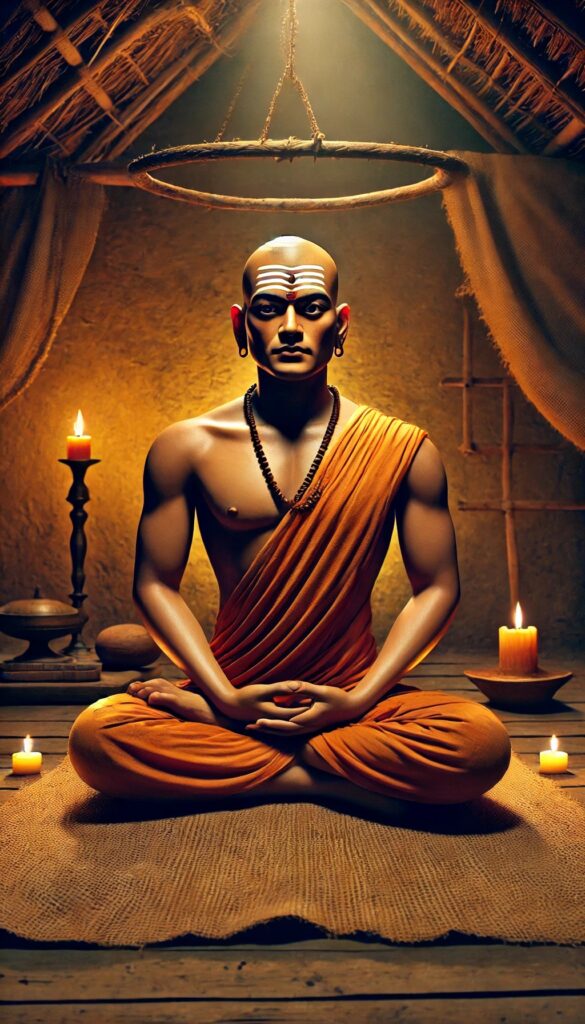
Training of Chandragupta Maurya
According to the Buddhist literature, Chandragupta was born near the Pataliputra (Patna, Bihar).
Chanakya inspected him with his criteria to check whether he could become an emperor of India.
For training, Chanakya took him to Takshashila (Taxila), currently in Pakistan. Where Greek and Hindu sculpture says completely differently that Chandragupta was an inhabitant student of Takshashila University and Chanakya was a native of the Takshashila region.
Taxilia (Takshashila) University
Chanakya already was a master at Takshashila University. He used to teach subjects economics and politics.
He used to train Chandragupta in his unique way. Like to improve alertness, Chanakya orders him to sleep on a tree for the entire night, putting thrones below the tree.
With this he practiced and learn slowly that how to keep the mind focused, awake, and alert even while sleeping. Chanakya had given him tough training of about eight years.
Apart from that, he also given him drop of poison everyday. Reason behind giving poison is from weapon attack Chandragupta can defense it. But, when anybody Betrayed and gave him a poison, then he should have ability to defense it as well. That each drop of poison made natural resistance against poison. That is the sole reason Chanakya used to give drop of poison each day in his meal.
Establishment of the Maurya Empire

The Buddhist literature says Chandragupta, after his education at Takshashila, started building his own army on small scale.
At that time, Alexandar was near Hindukush, which was assumed as a geographical boundary of Hindustan.
Chandragupta started wars two years after the retreating of Alexandar to Babylon in 325 BCE. Chandragupta won several Greek ruling cities.
These cities lie in the northwest subcontinent. After establishing his territory, he gathered forces and power.
Then he attacked Magadh and won the battle. Also killed the king of the Nanda Dynasty that is Dhana Nanda.
After capturing Magadh, he made a stable kingdom with a strong economy. For controlling taxes and tolls, he made a system to monetize and control roads and rivers.
Chanakya was the General Secretary in the Mauryan court of Chandragupta. Mauryan Empire was at its peak for almost three generations.

Mauryan Empire After Chandragupta Maurya
After Chandragupta, his son Bindusara had maintained the kingdom well. Then, the Great Ashoka expanded the kingdom towards the east and won Kalinga.
After that, he gave up the battles, but though he maintained the existing kingdom effectively. But his next generations became completely tranquil.
His next generations completely change the meaning of Buddhism. If you have ever seen the famous sculpture of Ashoka, that used on Indian currency. That sculpture was four sitting lions, which represents that,
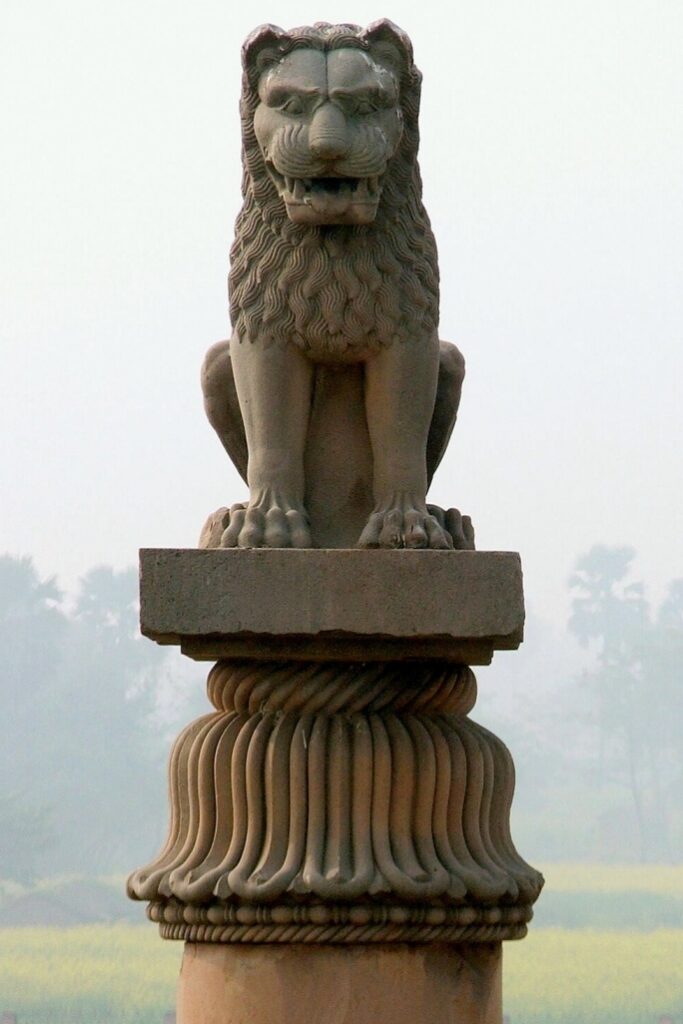
“We are lions, but we love peace.”
– Meaning of Sculpture made by Ashoka
Which does not mean if, someone was attacking you then, you should be calm. So, I think the upcoming generation of Ashoka misunderstood the meaning of Buddhism.
As a result, the kingdom diminished until the end of Mauryan Empire with last emperor named as Brihadratha. There are several reasons for decline of Magadh Empire.
Chandragupta established strong foundation for the several upcoming centuries. But unfortunately, rulers after Ashoka accepted Buddhism, which affected significantly on the Empire.
While Chandragupta Maurya founded the vast Mauryan Empire, his legacy was eventually overturned by Pushyamitra Shunga. Chandragupta’s establishment of a centralized administration and powerful military laid the groundwork for centuries of Mauryan dominance.
However, after the reign of Ashoka, the empire began to decline. This decline culminated in 185 BCE when Pushyamitra Shunga, the commander-in-chief of the Mauryan army, assassinated the last Mauryan emperor, Brihadratha.
This act marked the end of the Mauryan dynasty founded by Chandragupta and ushered in the Shunga dynasty under the rule of Pushyamitra.
He played a crucial role after the decline of the Mauryan Empire. As Pushyamitra fought with the Bactrian Greeks and repulsed them out of the Indian border. But still Indian history does not give prominence to Pushyamitra. But he was one of the most remarkable Indian freedom fighters.
Death of Chandragupta
Just as like death of Chanakya, no one knows about the death of Chandragupta. The reason is obvious because after abandoning his kingdom, Chandragupta converted to Jainism. According to teachings in Jainism he left the palace. He spent his last days in caves with Jain monks. Hence, most people are unaware of the death of Chandragupta
Lasting Impact of Chandragupta
The life and work of Chandragupta Maurya have left a lasting legacy on Indian history. The establishment of the Mauryan Empire not only unified the Indian subcontinent, but also demonstrated the effectiveness of strategic administration and military power. This historical narrative invites further exploration and discussion, encouraging the sharing of this rich legacy on social media to increase collective knowledge.
I hope you like this useful information on the history of Chandragupta Maurya. Don’t forget to share this on social media as its only way to grow and encourage us to create extraordinary content.
Featured Image Credits: आशीष भटनागर at Hindi Wikipedia [Public domain]
