
At young age of 26, Bhupendra Nath Datta reached a peak readership of 20,000 for the Jugantar newspaper before the British authorities arrested him for his revolutionary writings. We find Bhupendra Nath Datta Biography represents a unique blend of militant nationalism and profound academic scholarship that helped shape the intellectual foundations of modern India.
Key Takeaways
| Topic | Details |
|---|---|
| Primary Identity | Indian revolutionary, sociologist, and anthropologist. |
| Famous Relative | He was the youngest brother of Swami Vivekananda. |
| Major Contribution | Pioneered Marxist analysis of Indian society and history. |
| Academic Achievement | Earned a Doctorate from the University of Hamburg during his exile. |
| Preservation | We continue to study his legacy through digitized archives of his publications. |
What was Bhupendra Nath Datta’s role in the Indian independence movement?
He served as the editor of the revolutionary journal Jugantar and organized resistance against British rule both in India and abroad. We recognize him as a key figure in the early 20th-century nationalist movement.
Did Bhupendra Nath Datta write about ancient Indian history?
Yes, he applied a sociological lens to ancient texts, providing new perspectives on events like the Battle of Ten Kings through his dialectical research.
Early Life in the Datta Family of Simla
We trace the roots of Bhupendra Nath Datta to the celebrated Datta family of Simla in North Kolkata. He was born into a household that valued both traditional culture and modern education.
Datta was one of nine siblings in this intellectually vibrant family. This environment fostered a spirit of inquiry that would later define his dual career as a rebel and a researcher.
While his older brother, Narendranath (Swami Vivekananda), sought spiritual enlightenment, Bhupendra focused on the material liberation of the Indian people. We see his early years as a preparation for the radical shifts he would later introduce to Indian political thought.
His family life was often marked by financial struggle following the death of his father. Despite these hardships, we observe that the household remained a hub for intellectual discussion and social reform.

The Revolutionary Spark and the Jugantar Patrika
We recognize the founding of the Jugantar Patrika as a turning point in the Bengali resistance movement. Bhupendra Nath Datta took on the role of editor, using the platform to incite nationalistic fervor.
The newspaper was intentionally priced at just one paisa to ensure it reached the masses. This strategy allowed his revolutionary ideas to permeate even the lowest-income households of Bengal.
Under his leadership, the publication challenged British authority with unprecedented boldness. We find that the circulation grew rapidly as the youth of India sought a more direct path to freedom.
The British administration viewed his editorial work as a significant threat to colonial order. They closely monitored his activities, leading to frequent raids on the printing press and editorial offices.
The 1907 Arrest and the Path to Exile
In 1907, the British government finally moved to silence the radical voice of Jugantar. We note that Datta was arrested on charges of sedition for his uncompromising articles against the Crown.
He was sentenced to one year of rigorous imprisonment, a period that only strengthened his resolve. Upon his release, the constant surveillance by colonial police made further work in India nearly impossible.
Did You Know?
124,587 pages of the Jugantar Patrika, which Datta edited, have been digitized for preservation.
Source: British Library Endangered Archives Programme
To avoid further persecution, he chose the difficult path of exile in 1908. This decision began a seventeen-year journey that would take him across North America and Europe.
During these years, we see him transforming from a local agitator into an international revolutionary. He sought alliances with global movements that shared his goal of dismantling colonial empires.
Academic Excellence Across Three Continents
While in exile, Datta did not abandon his intellectual pursuits. We find it remarkable that he managed to balance revolutionary activism with intense academic study at world-class institutions.
He first traveled to the United States, where he enrolled at New York University. He eventually completed his Master of Arts degree at Brown University, focusing on the social sciences.
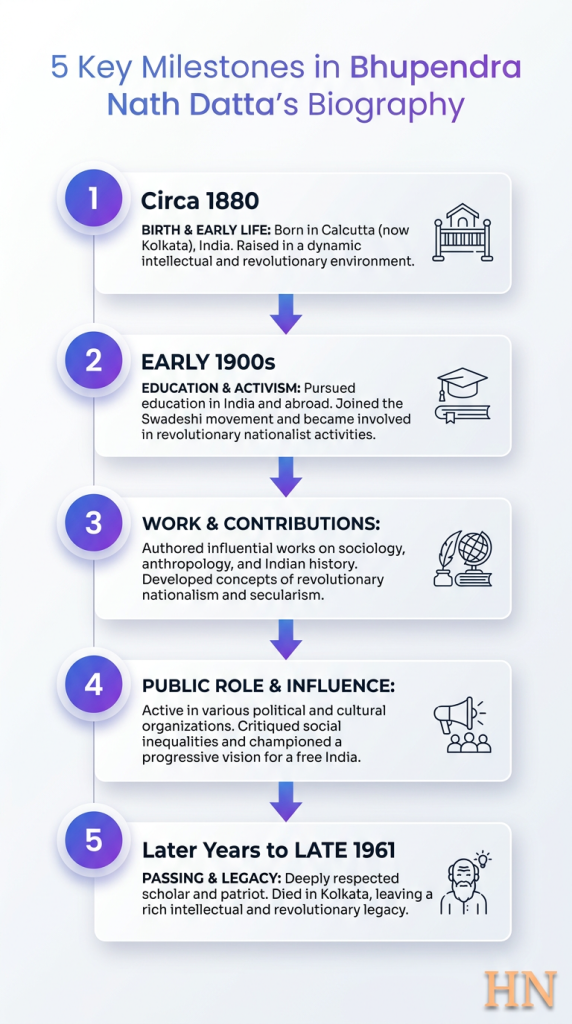
His academic journey then led him to Germany, a center for sociological research at the time. He earned his doctorate from the University of Hamburg, specializing in anthropology and sociology.
We consider his academic achievements as a testament to his high intellectual caliber. He was one of the few Indian revolutionaries of his era to hold three degrees from three different international universities.
The Berlin Committee and Global Anti-Colonialism
During World War I, Datta joined the Berlin Committee, also known as the Indian Independence Committee. We observe that this group worked closely with the German government to plan an armed uprising in India.
He collaborated with other famous revolutionaries like Virendranath Chattopadhyaya and M.N. Roy. Together, they attempted to ship arms and ammunition to Indian revolutionaries through secret channels.
Although many of these plans were intercepted by British intelligence, his work expanded the scope of the Indian freedom struggle. He helped place the Indian cause on the global political map during 2026 retrospectives of early resistance.
His time in Berlin also exposed him to the growing influence of socialist thought in Europe. We see this period as the foundation for his eventual shift toward Marxist sociology.
Transition to Marxist Sociology and Intellectual Growth
As we analyze his later career, we notice a profound shift toward Marxist ideology. He became convinced that political freedom without economic restructuring would not benefit the Indian masses.
He was among the first Indian scholars to apply historical materialism to the study of Indian history. This approach allowed him to analyze the caste system and religious rituals as social and economic constructs.
Did You Know?
He earned 3 major degrees from 3 different international universities (NYU, Brown, and Hamburg).
Source: Wikipedia
His research often challenged traditional views of ancient Indian society. By examining the material conditions of the past, he offered a more grounded understanding of India’s cultural evolution.
We believe his work as a sociologist was ahead of its time. He sought to bridge the gap between ancient Indian traditions and modern scientific analysis.
Returning to India: A Life Dedicated to the Masses
After seventeen years in exile, Datta finally returned to India in 1925. We find that he did not seek political power but instead focused on grassroots organization and scholarly writing.
He became deeply involved with the labor and peasant movements in Bengal. He believed that the real strength of the nation lay in its working-class population.
Despite his academic credentials, he lived a simple life, often working in the background. We note that he was a frequent speaker at trade union meetings and social reform conferences.
His return coincided with a shift in the nationalist movement toward mass mobilization. We see his influence in the growing popularity of socialist ideas within the Indian National Congress.
Literary Contributions and Historical Analysis
Throughout his later years, Datta remained a prolific writer and researcher. We highlight his major work, Dialectics of Hindu Ritualism, as a masterpiece of social analysis.
He also wrote extensively on the history of the Indian freedom movement. His memoirs provide a rare insider’s perspective on the secret societies of early 20th-century Bengal.
“The history of India is not merely the history of its kings and queens, but the history of its people and their struggle against exploitation.”
We recognize his efforts to document the lives of “missing heroes” who were forgotten by mainstream history. His writings continue to serve as a vital resource for historians in 2026.
He also contributed to the study of ethnography and anthropology in India. His diverse range of interests made him one of the most versatile intellectuals of his generation.
The Legacy of the “Missing Hero” in Modern India
In 2026, we observe a renewed interest in the life and works of Bhupendra Nath Datta. While he was often overshadowed by his famous brother, his own contributions are gaining recognition.
Researchers today describe him as a “missing hero” of Indian anthropology. Recent reviews highlight that despite his pioneering work, his academic contributions were neglected for decades.
We see efforts by cultural organizations to preserve his writings and promote his dialectical approach to history. His commitment to social justice remains relevant in modern sociological debates.
He remains an inspiration for those who believe in the power of combined intellectual and physical struggle. We find his biography provides a roadmap for balancing academic rigor with social activism.
Preserving the History of the Datta Ancestral Home
The ancestral home of the Datta family in Kolkata has become a significant site for historical preservation. We note that the library there houses over 6,500 books, making it a rich resource for scholars.
In 2025 and early 2026, the home hosted several events to honor his memory. These included cultural competitions and seminars focused on his revolutionary and academic legacy.
We encourage visitors to explore this site to understand the environment that produced such influential thinkers. The preservation of his personal effects and manuscripts offers a tangible connection to his life.
The site serves as a reminder of the intellectual depth of the Datta family. We view the continued interest in this location as a sign that his legacy is finally receiving the attention it deserves.
Conclusion
We conclude that Bhupendra Nath Datta was a figure of immense intellectual and political significance. His journey from a young revolutionary editor to a world-class scholar illustrates the diverse paths taken during the struggle for Indian independence.
While history often focuses on a few central figures, we believe it is essential to remember the contributions of thinkers like Datta. His work in Marxist sociology and his commitment to the masses provided a unique perspective on India’s past and future.
By studying his life, we gain a deeper understanding of the complex forces that shaped modern India. We remain committed to exploring the biographies of such “missing heroes” who dedicated their lives to both the pen and the sword.
As we look forward from 2026, his writings continue to offer valuable insights into the social and economic challenges facing our world. We invite you to read more about the Historic Nation to discover other figures who shaped our collective heritage.
