
A sentence of 6 years of rigorous imprisonment was the price Sagarmal Gopa paid for his unwavering courage in challenging the monarchy of Jaisalmer. This harsh penalty, handed down on charges of treason, only served to cement his status as a legendary figure in India’s struggle for independence.
Key Takeaways
| Topic | Quick Fact |
|---|---|
| Birth & Origins | Born in Jaisalmer in November 1900 to a family of patriots. |
| Major Literary Works | Authored “Jaisalmer Rajya Ka Gunda Shasan” and “Azadi Ke Diwane.” |
| Political Activism | Active participant in the Non-cooperation movement from a young age. |
| Tragic Martyrdom | Burned alive in prison on April 4, 1946, after years of torture. |
| Modern Honors | Commemorated with a 1986 postage stamp and a major canal branch name. |
Frequently Asked Questions
Where was Sagarmal Gopa born? He was a native of the Jaisalmer district in Rajasthan, belonging to a noble Brahmin family.
What were his most famous books? His most influential work was Jaisalmer Rajya Ka Gunda Shasan, which exposed the ruler’s atrocities.
How did Sagarmal Gopa die? He was brutally tortured and set on fire using kerosene while in custody at Jaisalmer Jail in 1946.
Early Life and the Birth of a Patriot in Jaisalmer
We trace the origins of Sagarmal Gopa to November 1900, when he was born into a prominent family in the princely state of Jaisalmer. His father, Akhairaj Gopa, served in the royal court, yet the young Sagarmal grew up with a deep sense of justice that often clashed with the local administration.
From his early childhood, we see a boy who was deeply moved by the plight of the common people under the Maharawal’s rule. His education and upbringing in Jaisalmer provided him with the tools to understand the systemic inequalities that plagued the desert kingdom.

The Non-Cooperation Movement and Gopa’s Political Awakening
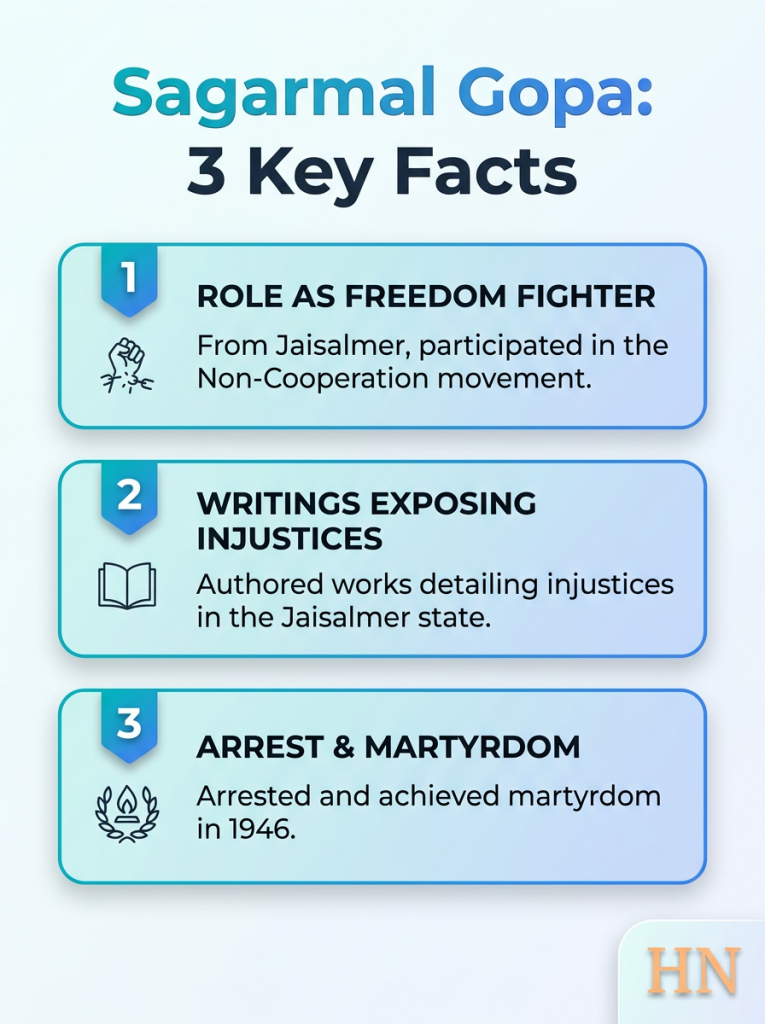
In 1921, at the age of just 20, Sagarmal Gopa joined the Non-Cooperation Movement led by Mahatma Gandhi. We recognize this as a pivotal moment in his biography, as it marked his transition from a local critic to a national revolutionary.
He actively organized protests and worked to spread political awareness among the masses in Rajasthan. His efforts were not just about removing the British but also about ending the internal oppression within the princely states.
Literary Resistance: Exposing the Atrocities through Books
We find that Gopa’s most potent weapons were not guns or swords, but his pen and his words. He authored three critical works that documented the harsh reality of life in Jaisalmer under the Maharawal’s reign.
His writings were considered so dangerous to the state that they were eventually banned by the authorities. These books served as a mirror to the administration, highlighting the corruption and cruelty that were common at the time.
Did You Know?
15 years old: The age at which Sagarmal Gopa established a public library in Jaisalmer to promote literacy and political awareness.
Source: Grokipedia 2026
The Impact of His Books: Jaisalmer Rajya Ka Gunda Shasan
The book Jaisalmer Rajya Ka Gunda Shasan (The Rule of Thugs in Jaisalmer State) remains his most famous contribution. We see it as a courageous exposé that detailed how the local administration exploited its subjects.
Another significant work, *Raghunath Singh Ka Mukadma*, focused on the legal injustices and the sham trials of the era. These publications made him a primary target for the state’s secret police and the ruling elite.
Facing Exile and the Struggle for Freedom Beyond Borders
Due to his revolutionary activities and provocative writings, Gopa was eventually exiled from Jaisalmer and Hyderabad. We note that even while in exile, he did not cease his activism, continuing to correspond with other freedom fighters across India.
He spent a significant amount of time in Nagpur, where he continued to rally support for the cause of independence. Despite being away from his homeland, his heart remained with the people of Jaisalmer, and he eventually returned to face his fate.

The Dark Years of Imprisonment and State Atrocities
In May 1941, Sagarmal Gopa was arrested upon his return to Jaisalmer, leading to a long and agonizing period of incarceration. We find accounts of his time in prison to be heart-wrenching, as he was subjected to continuous physical and mental torture.
The authorities attempted to break his spirit and force him to apologize for his “treasonous” writings. However, Gopa refused to yield, maintaining his dignity and his commitment to the freedom struggle even in the darkest of cells.
“The walls of Jaisalmer jail witnessed a level of brutality that few could survive, yet Gopa’s spirit remained uncrushable until his final breath.”
The Martyrdom of Sagarmal Gopa: A Final Sacrifice
On April 3, 1946, the cruelty of the state reached its peak when kerosene was poured on Gopa inside his prison cell. We record that he was set on fire, suffering horrific burns that eventually led to his death the following day, April 4.
This act of state-sponsored murder sparked widespread outrage across Rajasthan and the rest of India. His martyrdom became a rallying cry for the complete abolition of the monarchy in the princely states.
- Date of Incident: April 3, 1946
- Cause of Death: Severe burn injuries following torture.
- Legacy: Known as the “Martyr of Jaisalmer.”
National Recognition and the 1986 Commemorative Stamp
Decades after his death, we see the Indian government officially recognizing the immense contribution of this unsung hero. In 1986, a commemorative postage stamp was issued to honor his bravery and literary contributions to the freedom movement.
This Sagarmal Gopa Commemorative Stamp had a face value of 0.50 INR and has since become a valued item for collectors. It serves as a permanent reminder of the sacrifices made by regional leaders in the pursuit of a unified India.
Did You Know?
100% inclusion: His presence in major Rajasthan state competitive exams (RPSC/RSMSSB) as of January 2026 mock sessions.
Source: Testbook 2026
Modern Legacy: The Sagarmal Gopa Branch Canal
His name lives on not just in history books, but also in the vital infrastructure of Rajasthan. We recognize the Sagarmal Gopa Branch Canal as a significant tribute to his enduring presence in the region.
This branch of the Indira Gandhi Canal brings life-giving water to the arid lands he once fought to liberate. It is a fitting legacy for a man who dedicated his life to the welfare and prosperity of his people.
Sagarmal Gopa in Competitive Exams and Contemporary History
As of 2026, the biography of Sagarmal Gopa is an essential topic for students and civil service aspirants in India. We find that questions regarding his life and works are frequently featured in state-level exams like the RPSC.
Learning about his struggle helps the younger generation understand the complexities of the independence movement within the princely states. His story continues to inspire researchers and historians who seek to document the “unsung heroes” of India’s past.
Conclusion
We believe that the biography of Sagarmal Gopa is a testament to the power of the written word and the resilience of the human spirit. From his birth in Jaisalmer to his tragic martyrdom in 1946, his life was a continuous battle against injustice and oppression. As we move through 2026, his legacy remains as relevant as ever, reminding us of the heavy price paid for the freedoms we enjoy today. For more historical insights, you can visit Historic Nation to explore the lives of other patriots who shaped our world.
