
Mahatma Gandhi famously remarked that if India had just ten leaders like Satyamurti in the legislatures, the British would have been forced to leave much earlier. We explore the extraordinary journey of this titan of the Indian independence movement, whose voice echoed through the halls of power as a champion of self-rule.
Key Takeaways
| Topic | Details |
|---|---|
| Who was S. Satyamurti? | He was a prominent Indian independence activist, lawyer, and politician from the Madras Presidency known as “Dheerar.” |
| What was his major contribution? | He was a legendary orator and parliamentarian who mentored future leaders like K. Kamaraj. |
| When did he serve as Mayor? | He served as the Mayor of Madras from 1939 to 1943, initiating the Poondi reservoir project. |
| Why is he called “Dheerar”? | The title means “The Brave One,” earned through his fearless opposition to British colonial policies. |
| How can I learn more? | You can find detailed archival records at the S. Satyamurti biography page or visit national history portals. |
- Born on August 19, 1887, in Thirumayam, Pudukkottai.
- Excelled as a lawyer before entering full-time politics under S. Srinivasa Iyengar.
- Played a pivotal role in the Swaraj Party and the Indian National Congress.
- Led the campaign for the 1937 elections, resulting in a landslide victory in Madras.
- Suffered significant physical hardship during multiple imprisonments for the freedom struggle.
- A commemorative stamp was issued in his honor by the government in 1987.
- For more on historical dates, see this history record of March 28.
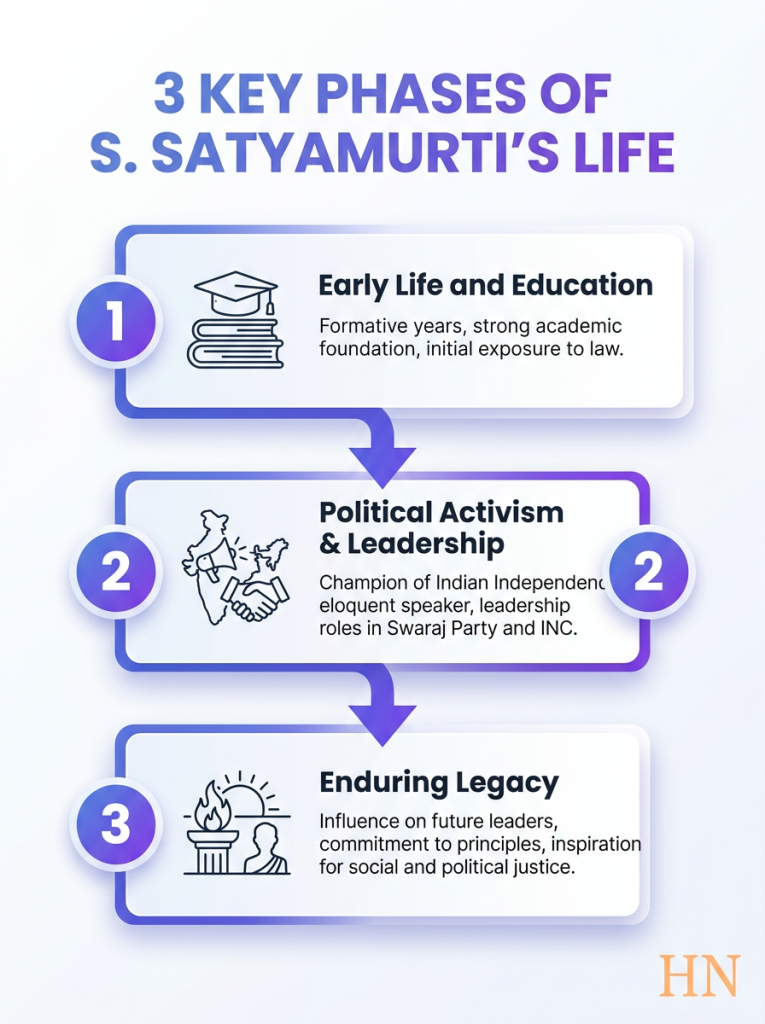
Early Life and Education in the Heart of Pudukkottai
Sundara Sastri Satyamurti was born into a scholarly family in Thirumayam, located in the princely state of Pudukkottai. We recognize his early environment as a catalyst for his intellectual growth and future legal prowess.
He pursued his higher education at Maharajah’s College in Pudukkottai before moving to the prestigious Madras Christian College. There, he earned his BA degree and developed the foundational skills that would later define his public life.
His academic journey continued at Madras Law College, where he prepared for a career in the legal profession. We see this period as the time when he honed the logical reasoning and sharp wit he would use against colonial authorities.

The Formative Legal Years and Initial Political Engagement
Upon completing his legal studies, Satyamurti began practicing law in Madras. We note that his legal acumen quickly gained him respect within the judicial circles of the Madras Presidency.
It was during this time that he met S. Srinivasa Iyengar, a leading lawyer and political figure who became his mentor. This relationship proved decisive, as Iyengar encouraged the young lawyer to channel his energy into the freedom movement.
Satyamurti’s entry into politics was not a gradual shift but a passionate embrace of the national cause. He began participating in protests against the Partition of Bengal, marking his first steps onto the national stage.
A Master of Oratory in the Central Legislative Assembly
Satyamurti was widely acclaimed for his rhetoric and became one of the leading voices of the Indian National Congress. We believe his ability to dismantle colonial arguments with logic and flair was unmatched during his era.
He served as the Deputy Leader of the Congress Party in the Central Legislative Assembly. His presence in the assembly ensured that the Indian perspective was heard clearly by the British administration.
His speeches were not merely political statements but masterclasses in parliamentary procedure and debate. We find his dedication to constitutional methods particularly noteworthy in an era of mass civil disobedience.
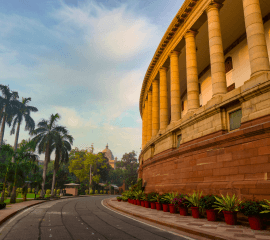
Standing Against Colonial Injustice: The Rowlatt Act Protests
In 1919, the Congress sent Satyamurti as a delegate to the Joint Parliamentary Committee in the United Kingdom. We recognize this as a critical mission to protest the repressive Rowlatt Act and the Montagu-Chelmsford reforms.
His trip to England allowed him to present the grievances of the Indian people directly to the British public and parliament. He spoke at various forums, exposing the cruelty of colonial laws and the massacre at Jallianwala Bagh.
Upon his return, he continued to be a thorn in the side of the British administration. We observe that his fearless stance against the Simon Commission further solidified his reputation as “Dheerar.”
“The spirit of a nation cannot be crushed by repressive laws; it only gains strength with every attempt to silence it.”
— Inspired by the oratory of S. Satyamurti.
Leading the Indian National Congress in Madras
Satyamurti’s leadership in the Madras Presidency was characterized by his organizational brilliance. We consider his efforts in building the Congress party’s grassroots presence in South India to be essential for the movement’s success.
He was a key figure in the Civil Disobedience Movement and was frequently arrested for his activities. Despite these setbacks, we see that he never wavered in his commitment to the struggle for independence.
His role in the 1937 provincial elections was particularly significant, as he campaigned tirelessly across the region. His efforts helped the Congress secure a massive majority, changing the political landscape of Madras forever.
The Swaraj Party and the Fight for Internal Self-Rule
When the Congress was divided over the issue of council entry, Satyamurti joined the Swaraj Party. We recognize this move as a strategic choice to fight the British from within the legislative system.
He believed that by occupying legislative seats, Indian leaders could obstruct the colonial government’s repressive measures. His performance in the Madras Legislative Council was marked by sharp questioning and brilliant debating skills.
Through the Swarajist platform, he advocated for greater autonomy and the rights of Indian citizens. We view his work during this period as a vital bridge between revolutionary activism and modern parliamentary democracy.
- Advocacy for Internal Reforms: He pushed for localized governance.
- Legislative Obstruction: He used procedural rules to halt unfair colonial bills.
- Public Awareness: His debates were published widely to educate the masses.
Solving the Water Crisis: Satyamurti’s Tenure as Mayor
In 1939, Satyamurti was elected as the Mayor of Madras during a period of severe water scarcity. We appreciate his vision in addressing this critical infrastructure need during the height of World War II.
He was instrumental in the commissioning of the Poondi reservoir, which was later named Satyamurti Sagar in his honor. This project remains a primary source of water for the city of Chennai to this day.
His tenure as Mayor showed that he was not just a politician of words but also a man of action. We see his administrative success as a testament to his dedication to the welfare of the common people.
The Kingmaker’s Mentor: Shaping the Career of K. Kamaraj
One of Satyamurti’s most enduring legacies is his mentorship of K. Kamaraj. We understand that Satyamurti recognized the potential in the young activist and helped him navigate the complexities of national politics.
Kamaraj often referred to Satyamurti as his political guru and credited him with his own rise to leadership. This relationship bridged two generations of the independence struggle in South India.
Even after Satyamurti’s passing, Kamaraj continued to honor his mentor’s ideals throughout his own career as Chief Minister. We view this lineage of leadership as a vital part of the political history of Tamil Nadu.
Key Mentorship Impacts
- Grassroots Mobilization: He taught Kamaraj the importance of connecting with the masses.
- Strategic Planning: He shared his insights on navigating party politics.
- Integrity in Office: He modeled the behavior of a selfless public servant.
Sacrifice and Struggle during the Quit India Movement
In 1942, Satyamurti was arrested for his participation in the Quit India Movement launched by Mahatma Gandhi. We note that this final period of incarceration was particularly harsh on his health.
During his time in Amravati Jail, he sustained a severe spinal injury that left him debilitated. Despite his failing health, his spirit remained unbroken as he continued to inspire fellow prisoners.
He was eventually released on health grounds but never fully recovered from the toll of prison life. We reflect on his passing on March 28, 1943, as a profound loss for the nation just a few years before independence.
His life story is detailed in various historical texts, including the Satyamurti IAS preparation notes used by students today. We continue to learn from his sacrifices as we approach the mid-2020s.
Honoring a Patriot: Statues, Stamps, and Modern Remembrance
In the decades following independence, the Indian government has honored Satyamurti with several commemorations. We see these gestures as essential for keeping his memory alive for future generations.
A commemorative postage stamp was issued on August 22, 1987, to mark his birth centenary. This stamp recognized him as a “Patriot and promoter of arts,” acknowledging his diverse contributions to society.
A bronze statue of Satyamurti also stands in the Parliament House of India, unveiled to celebrate his role as an outstanding parliamentarian. We believe his legacy continues to inspire those who walk the halls of Indian democracy in 2026.
For more details on national honors, you can visit the Tamil Nadu Philately records. We also recommend checking the Parliament of India website for archival information on his speeches.
Conclusion
The biography of S. Satyamurti is a story of unmatched oratory, deep-seated patriotism, and administrative brilliance. We remember him as the “Dheerar” who fearlessly challenged an empire while building the foundations of a modern city.
From his early days in Pudukkottai to his final sacrifice during the Quit India Movement, his life was dedicated to the service of others. As we look back from the year 2026, his contributions to the Madras Presidency and the Indian National Congress remain vital chapters in our history.
We invite you to explore more about his life and work through the resources provided throughout this article. His legacy as a mentor, mayor, and master orator continues to shape the democratic ideals of India today.
