
The Maruthu Pandiyar brothers represent a pivotal era of resistance against colonial expansion in South India during the late 18th century. It is a striking historical fact that they issued a call for independence 56 years before the 1857 Sepoy Mutiny, challenging the British narrative of when Indian resistance truly began.
Key Takeaways
| Feature | Details |
|---|---|
| Full Names | Periya Maruthu and Chinna Maruthu |
| Key Achievement | Jambudvipa Proclamation of 1801 |
| Region | Sivaganga, Tamil Nadu |
| Execution Date | October 24, 1801 |
- Who were the Maruthu Pandiyar brothers? They were the rulers and military commanders of the Sivaganga kingdom who fought against the British East India Company.
- What is their main legacy? They are credited with the first formal proclamation of independence in India, known as the Jambudvipa Proclamation.
- Where can I read more about their history? You can find a detailed Maruthu Pandiyar Brothers Biography on our history portal.
- Why is Guru Pooja celebrated? It is the annual remembrance day held in Sivaganga to honor their sacrifice and bravery.
The Origins and Early Life of the Maruthu Brothers
We begin our journey in the village of Mukkulam, where the brothers were born to Mookiah Palaniappan and Ponmathi. The elder brother, Periya Maruthu, was born in 1748, followed by the younger, Chinna Maruthu, in 1753.
Our research into the Historic Nation records shows that they were trained in traditional martial arts from a very young age. They mastered the use of the Valari, a traditional Tamil boomerang, and were experts in archery and sword fighting.
The brothers did not come from a royal lineage, but their physical prowess and intelligence quickly caught the eye of the local nobility. We see them emerging as natural leaders who were deeply connected to the soil and the people of the Sivaganga region.
The Distinction Between the Brothers
Periya Maruthu, often called Vella Maruthu, was known for his immense physical strength and expertise in hunting. He was a man of few words who preferred the quiet life of the forest and the battlefield.
Chinna Maruthu was the strategist and the diplomat of the duo. He handled the administrative affairs of the kingdom and was responsible for building alliances with other regional leaders.
Rising Through the Ranks in Sivaganga
The brothers entered the service of Muthu Vaduganatha Periyavudaya Thevar, the King of Sivaganga. They started as royal guards but quickly rose to become the King’s most trusted military commanders.
During this period, the British East India Company was beginning to exert pressure on local rulers to pay tribute. The brothers played a vital role in organizing the defense of the kingdom against these early colonial encroachments.
We find that their loyalty to the King was absolute. This bond was tested when the British forces, led by Colonel Bon Jour, launched a surprise attack on the Kalayar Kovil palace in 1772.
The King was tragically killed in this battle, which changed the course of the brothers’ lives forever. They vowed to reclaim the kingdom and protect the King’s widow, Queen Velu Nachiyar.
The Resistance and the Era of Queen Velu Nachiyar
Following the King’s death, the Maruthu brothers retreated into the dense forests of the region. They successfully escorted Queen Velu Nachiyar to safety in Dindigul, where they sought the protection of Hyder Ali.
Over the next eight years, we observe the brothers meticulously rebuilding their forces and planning a comeback. They organized a guerrilla army and maintained a secret network of informants throughout the occupied Sivaganga territory.
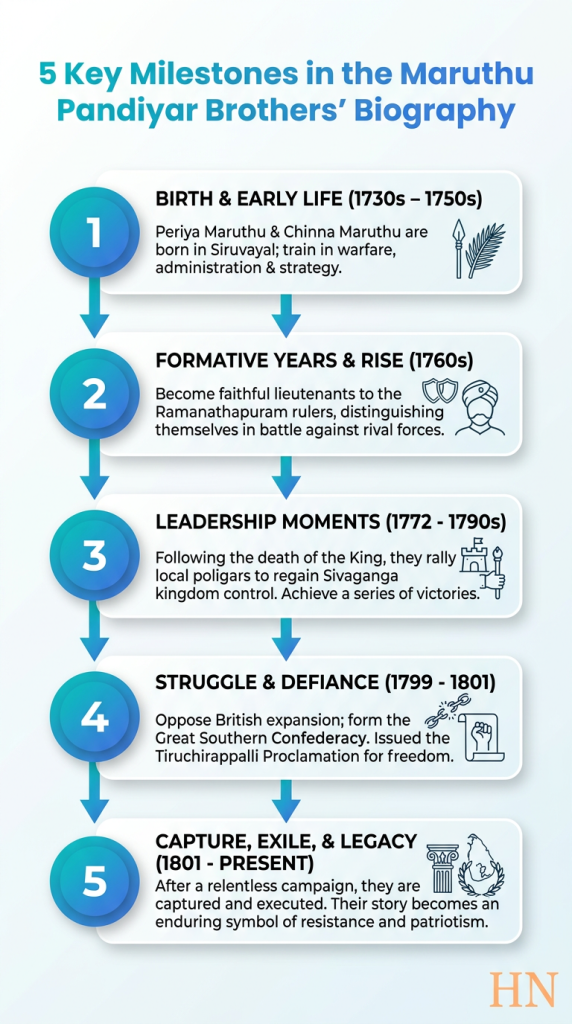
A concise visual timeline of 5 pivotal moments in the Maruthu Pandiyar Brothers’ biography. It highlights their role in anti-colonial resistance.
In 1780, they launched a brilliant counter-offensive to retake Sivaganga. The brothers led the charge while the Queen’s commander, Kuyili, performed a legendary act of self-sacrifice to destroy the British ammunition dump.
With the kingdom reclaimed, Queen Velu Nachiyar was reinstated as the ruler. However, the Maruthu brothers became the de facto administrators, managing the daily affairs of the state and its military defenses.
The Jambudvipa Proclamation of 1801
The year 1801 marked a significant turning point in Indian history. The Maruthu brothers realized that isolated rebellions were not enough to stop the British, so they called for a unified front.
They issued the Jambudvipa Proclamation, which was posted on the walls of the Srirangam Temple and the Nawab’s palace in Tiruchirappalli. This document was a formal declaration of independence and a call to arms for all Indians, regardless of religion or caste.
“The Europeans, having come to this country for trade, have taken over the administration. Whoever allows this to continue is a traitor to the land.”
We consider this document to be the first of its kind in India. It predates the modern nationalist movements and shows a sophisticated understanding of colonial exploitation.
Did You Know?
On October 24, 1801, the British executed the brothers alongside approximately 500 of their followers, one of the largest mass executions of freedom fighters in a single day.
Source: VSK Tamil Nadu 2023
Administrative Excellence and Public Works
Beyond their military roles, the brothers were exceptional administrators. They focused on irrigation, temple construction, and the welfare of the common people during their 21-year reign.
We find evidence of their work in the many tanks and canals they built to support agriculture in the dry Sivaganga region. They believed that a prosperous populace was the strongest defense against foreign rule.
They also renovated several major temples, most notably the Kalayar Kovil temple. Their architectural contributions are still visible today, standing as a testament to their devotion and vision.
The brothers were also known for their religious tolerance. They provided grants to mosques and churches, fostering a sense of unity among their diverse subjects.
Military Tactics and Guerrilla Warfare
The Maruthu brothers were masters of the terrain. They used the dense forests of Kalayar Kovil and Piranmalai to their advantage, making it impossible for the British to use their traditional heavy artillery.
We see that they pioneered the use of small, highly mobile units that could strike quickly and disappear. This “hit and run” strategy exhausted the British troops and depleted their resources.
They also utilized the Valari weapon effectively in close combat. This curved throwing stick could be used to disarm opponents or strike from a distance with surprising accuracy.
Our analysis of the conflict shows that they also established a sophisticated communication system using drums and secret signals. This allowed them to coordinate attacks across vast distances without the British intercepting their messages.
The Alliance with Kattabomman and Other Rebels
The Maruthu brothers did not fight alone. They formed a powerful confederacy with other rebel leaders like Veerapandiya Kattabomman of Panchalankurichi and Dheeran Chinnamalai.
When Kattabomman was captured and executed in 1799, his brother, Oomaithurai, fled to Sivaganga. The Maruthu brothers gave him asylum, which directly provoked a full-scale war with the British.
We find that this alliance was based on a shared vision of a free India. They coordinated their efforts to disrupt British supply lines and tax collection across South India.
The British realized that as long as the Maruthu brothers were active, they could never fully control the region. This led to the massive military mobilization of 1801, involving thousands of colonial troops.
The Final Stand at Kalayar Kovil
The British launched a multi-pronged attack on Sivaganga in 1801. The brothers fought valiantly, defending their forts and forests for several months against overwhelming odds.
Despite their superior tactics, the British eventually managed to find a path through the dense forests. They used local informants to navigate the terrain and surround the rebel strongholds.
The brothers were eventually captured in the forests near Cholapuram. They refused to surrender, choosing to fight until they were physically incapacitated by their wounds.
We see this final battle as a moment of extreme courage. Even in the face of certain defeat, they remained defiant and committed to their cause.
Did You Know?
In an attempt to wipe out their lineage, the British executed almost all male family members, sparing only one son, Doraisamy, who was banished to Penang, Malaysia.
Source: PL RAJ IAS Academy 2024
The Execution at Tirupattur and Total Sacrifice
On October 24, 1801, the Maruthu brothers were hanged at the Tirupattur Fort in Sivaganga district. They met their end with dignity, asking the British to spare their people and the temples they had built.
The British, however, were determined to set a terrifying example. They executed hundreds of the brothers’ followers and family members on the same day.
We find that the British went to great lengths to erase the brothers’ legacy. They demolished many of their structures and tried to suppress the stories of their heroism among the local population.
However, the spirit of the Maruthu brothers could not be extinguished. Their story was preserved through folk songs and oral traditions, passing from one generation to the next.
Legacy and Modern Remembrance in 2026
Today, the Maruthu Pandiyar brothers are revered as folk heroes and national icons in Tamil Nadu. Their sacrifice is celebrated every year during the Guru Pooja, which draws thousands of devotees to Sivaganga.
In 2026, we see their legacy continuing to inspire social and political movements in the region. Their emphasis on unity and resistance against oppression remains as relevant as ever.
The Government of Tamil Nadu has recognized their contribution by erecting memorials and statues in their honor. The Tirupattur Fort and the Kalayar Kovil temple have become major sites of historical pilgrimage.
We believe that their biography serves as a powerful reminder of the deep roots of Indian freedom. They were not just local chieftains, but visionary leaders who dreamed of a sovereign nation.
Conclusion
The Maruthu Pandiyar brothers’ biography is a tale of extraordinary courage, administrative skill, and ultimate sacrifice. They were among the first to recognize the threat of colonial rule and the first to offer their lives to stop it.
As we look back from the perspective of 2026, we recognize that their contributions laid the groundwork for the centuries of struggle that followed. We encourage you to explore more about our shared heritage at Historic Nation to keep these stories alive.
Their life reminds us that true leadership is about serving the people and standing up for justice, no matter the cost. We honor the “Lions of Sivaganga” for their eternal spirit and their role in the dawn of Indian independence.
